IMPORTANT NEWS: National Electric Vehicle Sweden has agreed to buy the assets of Saab Automobile and the sale is expected to be finalized during the summer.
Showing posts with label future saabs. Show all posts

Tuesday, April 10, 2012

Recent Saab patent filings

Today when the bankruptcy administrators filed their assessment of the bankruptcy estate, some interesting information was revealed. For instance which patents Saab has filed the last two years.

Below we can see that Saab has filed a lot of patents concerning EREV (extended range electric vehicle), several patents concerning clutch, gear and transmission. And even a patent for a hat rack!


Monday, February 20, 2012

Next Saab 9-3 is a gorgeous somewhat retro-inspired car

For anyone understanding Swedish I recommend listening to Swedish Radio P4 Väst's interview with Anna Petre. Anna Petre was of course head of Saab's public affairs and was deeply involved in the attempts at saving Saab up until the end.

Here's the interview:

Lyssna: Anna Petre om tiden med Saab

For readers who do not understand Swedish, I will just translate two questions and answers from the interview:

Do you think GM is willing to give access to its licenses?

"I think it's easier for them to license the 9-5 than the 9-4. On the other hand, it can only give GM incomes, so I find it hard to see that it would be totally and completely out of the question. I don't think it is. It should be possible to negotiate with them and find some sort of solution.

There has been much talk about the new generation 9-3. Have you seen it?

"Yes, it's gorgeous. The car is a bit retro-inspired. The exterior is one thing, but I really hope that we can actually achieve the ideas we had about the environment and the Saab brand."

Friday, December 30, 2011

Design of Saab 9-3 replacement more or less finished

When Saab on December 19th filed for bankruptcy, the design of the Saab 9-3 replacement was more or less finished. To TTELA head of Saab design, Jason Castriota, says that they were working on the finishing touches when the bankruptcy happened.

Here's a translation of the interview Castriota did with TTELA:

"It's frustrating not being able to see the new car"

They were putting the finishing touches on the new 9-3 model's design when the bankruptcy happened.

"It's so frustrating to think that it's not going to be out on the roads, I know how competitive it is. But I have not given up yet," says Saab chief designer Jason Castriota.

TTELA reaches Jason Castriota at home in New York where he is celebrating Christmas with his family. He says that they were doing the very last details on the 9-3 when the bankruptcy became a fact.

"We were working hard to get it ready in view of the vulnerable situation Saab was in."


He describes how the work on the 9-3 was in the final stages.

"We would soon put prototypes of the model out on the roads to really test the car. To think that this car would not be built is impossible for me, I know what car this would be. I have worked for major automotive companies and know the 9-3's qualities. It is incredibly frustrating if this car will not be built when at the same time I know that less competitive cars are being sold and are out on the roads. The car is also very competitive in terms of size."

More models

He also tells how they were about to go on to develop more models on the Phoenix platform.

"The work to look at the bandwidth and the size of future models on Phoenix had begun. We have had this kind of cooperation. The spirit during the development has been fantastic and even the collaboration with Mats Fägerhag, Kjell ac Bergström and all teams involved."

There are many indications for continuation

Jason Castriota says that there are many indications of a continuation, after all.

"The Saab brand is so strong and this model is so valuable that I can not imagine that there wouldn't be a continuation. We worked for 20 months on this project. If it would not be built under the Saab name, one must hope that at least it will be under a different name. I really hope the administrators can take advantage of the values here. And that the facilities and personnel in Trollhättan remain involved in car production. When I went to Trollhättan the town's ability to innovate really hit me, although it is not such a big place."

He does not know what will happen now.

"We went on Christmas holiday right after what happened last week and have not seen each other since. I've only had contact with Victor Muller on text messages, he is busy in his own way right now. We'll see, but as I've said I hope for a continuation."

Wednesday, December 21, 2011

Fancy a Saab 9-3 with a Fiat engine?

Would you fancy a good old Saab 9-3 with a Fiat engine? If Youngman gets to buy the bankruptcy estate from Saab and restarts production of the current 9-3 in Trollhättan awaiting the arrivial of the next generation Saab vehicles, that can be the case.

From earlier we know that Saab has rights to most of the technology in the current Saab 9-3. Only parts of this technology is owned by GM. I assume that e.g. the engines, and especially the new direct injection petrol engine, is GM unique technology and thus technology GM wants to protect. But now news reports say that Youngman wants to source engines from Italy instead. And who else than Fiat could be the supplier? VM Motori? I think Fiat and the reason is as follows.

The diesel engine used in the Saab 9-3 was originally developed by Fiat-GM-Powertrain before the two companies decided to end the partnership. Fiat uses the same engine in both Fiat cars and Alfa Romeo cars. Maybe even in Lancia? Anyway, since this engine is more or less similar to the diesel engine Saab has sourced from GM, a engine swop should be doable.

I am not sure if a swop is just as simple when it comes down to petrol engines. The engine mounts should be more or less the same, but the engines are very different I guess. But nothing is impossible, right?

So if everything goes well, we might be driving Italian powered Saabs the next two years or so!

Monday, November 28, 2011

Saab 9-3 impression from Teknikens Värld

A couple of weeks ago Svenska Dagbladet presented a grainy picture of what was believed to be the upcoming Saab 9-3 replacement. Since then we have seen impressions of this new car from both AutoExpress and AutoWeek. Today I bring you some new impressions from Teknikens Värld.


Do we believe this is the next 9-3? Teknikens Värld believes it is, but in my opinion  does at the same time give the best possible explanation why it is not:

They write that the 9-3 that was already designed when Jason Castriota arrived at Saab looked too much like a scaled down Saab 9-5. And therefore Victor Muller gave Castriota the task to give it a new design.

And in my opinion, this impression looks too much like a scaled down 9-5. Look at the front with the overhang, the window lines, the sloping rear. All 9-5.

Don't get me wrong, I like this impression a lot. Especially the picture from the front angle, but I believe that the next 9-3 will look different.

Wednesday, November 16, 2011

Saab's current and future platforms

All the current Saab models use platforms or architectures developed under GM or by GM. But it differs to which extent this technology is owned by GM or Saab.

The oldest Saab in the fleet, the Saab 9-3 which was launched as model year 2003 and reworked in 2008, uses the first generation Epsilon platform. According to Swedish technology news site, Ny Teknik, only parts of the technology in the current Saab 9-3 is owned by GM. Saab has the rights to most of the technology, and can use the technology owned by GM without paying license fees.

The Saab 9-5 which was launched as a model year 2010 car, is entirely based on technology owned by GM. Much of the technology was developed by Saab when Saab was owned by GM, but Saab still has to pay license fees to GM to use the 9-5 technology.

The new Saab 9-4X launched as a model year 2011 car, is also entirely based on technology owned by GM. And it does not just use GM technology, it is also built by GM in Mexico for Saab. So Saab doesn't even own the tools needed to build the car.

The fact that GM owns all technology used in the 9-4X and 9-5, and some of the technology used in the 9-3, is of course the reason why GM's blessing is needed to sell Saab to the Chinese companies Youngman and PangDa. Without GM licenses, Saab can't build cars in the near future. And no cars means no incomes and a dead brand.

But then what about the next generation of Saabs?

I have already published an article about how the next generation Saab cars will be built on Saab's own Phoenix platform which has been in development since 2008. And also an article about the Phoenix platform actually still using some GM technology. But now let's look more into that. Here Ny Teknik is also our source of information.

The first car scheduled to use the Phoenix platform is the Saab 9-3 replacement. If everything goes well, the car should launch sometime in 2013. About half of the components and technology of this car comes from external suppliers and subcontractors. Including a number of compenents and systems from GM. These are components and systems the developers at Saab have taken from the Saab 9-3 and 9-5 and that they from experience know to be good and reliable.

These GM systems are so called competition-neutral components. Which means that the technology is no longer unique and gives no competitive edge. GM has the rights to these components because GM owns the tools used by the components suppliers. And therefore GM also decides who can buy the components.

The reason why Saab decided to use these systems, except for the obvious reason that they know them from the current Saab cars, is because Saab saves a lot of money by buying finished components as opposed to Saab developing and building the components.

When we look at the Saab 9-3 replacement, less than 10 percent of the components or 500 part numbers, are GM components.

This means that if Saab is to build the Saab 9-3 replacement based on 10 percent GM components, Saab needs GM to approve the sale of these components. On the other hand, if GM says no, Saab needs to find new suppliers or develop the parts itself. And since the parts are more or less off the shelf components, it should not pose any big problem. Except that it would of course increase the cost and delay the launch date of the 9-3 replacement.

So to conclude: Saab can not build any of the current models without GM's blessing, but future models based on the Phoenix platform can be built regardless of GM.

Another aspect that has not been discussed here is engines deals. Currently Saab buys all its engines from GM, and in the 9-3 replacement we know that Saab will buy the base petrol engine from BMW. If both GM and BMW says no to selling engines to a Chinese-owned Saab, then Saab even needs to go shopping for new engines. But from where? And how will that increase the cost and delay the 9-3 replacement?

Tuesday, November 15, 2011

Nice Saab 9-3 impression from AutoWeek


Here is a nice Saab 9-3 impression from AutoWeek, spotted by Tobias A!


This impression was obviously based on the current Saab 9-5 Sedan, and does probably not look much like the next Saab 9-3. But it could maybe be close to a faceliftet Saab 9-5 Sedan to launch around 2013?

Thursday, November 10, 2011

Next generation 9-3 revisited

Monday last week a grainy picture of what was supposed to be the next generation Saab 9-3 scheduled to be launch in 2013 emerged. I questioned if this really could be the next 9-3. To my eyes it looked too much like a photoshopped Saab 9-5.

Now British magazine Autoexpress has made a full-fledged photoshop based on that grainy picture. And more than ever I am questioning if this really can be the next 9-3.


In my opinion the Autoexpress photoshop proves that with a few hours of photoshopping based on the Saab 9-5 and voilà you got the next generation 9-3. And we don't believe that the next 9-3 was that easy to design, do we?

Wednesday, November 9, 2011

Saab dependent on GM the coming years

On Monday General Motors made a statement that the company will not continue to supply Saab with technology for the production of the Saab 9-3 and Saab 9-5 and not deliver the Saab 9-4X from the Mexico production plant if Saab is sold to the Chinese companies Youngman and PangDa as planned.

This would of course immediately remove all of Saab's current vehicles. But I know that some might say "Forget GM, let's make new Saabs on the new Phoenix architecture developed by Saab!".

And that is of course an interesting thought. And in time Saab plans to move all its vehicles over to the Phoenix architecture. The problems it that it takes time. First of all, the technology isn't fully developed yet. Remember that the first car on Phoenix was supposed to be launced at the end of 2012. Now with all that has happened this year, the launch date will probably be 6 to 12 months later. So no cars until summer or autumn 2013. That doesn't sound like a viable plan does it? Even if Saab would lay-off half of the work force temporary for two years, the costs to run the company would be enormous and the incomes would be miniscule. And if Saab isn't present on the market for the next two years, then what about the dealers - how will they surive? And will the car buyers be back to buy Saabs after two years off the market?

But that is not the only problem. Another problem is the Phoenix architecture. At the moment the Phoenix architecture is actually not 100 percent Saab. It is a hybrid of Saab developed technology and GM owned technolgy.

"It concerns some systems and components which GM owns and we have permission to use," Peter Zienau, Director Electrical Integration Vehicle Engineering at Saab says to TTELA. But he also points out that this is the current situation.

"The long-term strategy is to be fully independent of GM."

In other words, not even the Phoenix architecture in its current form is fully owned by Saab. And so there is only one way of survival for Saab: Raise funding and make partnerships that GM can accept.

Monday, October 31, 2011

Next generation Saab 9-3

Swedish SvD has come across a presentation of Saab's business plan from January 2011 with a picture of what is believed to be the next generation Saab 9-3.


Looking interesting, doesn't it?


In the rear we can recognize the current Saab 9-5 Sedan with the sloping rear. The rear wheel arch looks a bit like the Saab PhoeniX concept. We have the wrap-around windshield and the blacked out A-pillars from the Saab 9-5.


But is this the real deal?


Well, to me it looks too much like a Saab 9-5 photoshopped into a Saab 9-3.


First of all, the rear looks too much like a slightly altered Saab 9-5 Sedan. And there is still a big front overhang. Earlier Saab has said that they have worked hard on reducing the front overhang on the next 9-3. Furthermore, we have been told that the front fender will be bigger and more pronounced than on the Saab PhoeniX. I don't see that on this picture. But it does look a lot like a Saab.


What do you think?

Thursday, September 22, 2011

New valuable Saab technology

Today Swedish news site NyTeknik has several articles about Saab's upcoming technology. Here is a summary of the main points.

Phoenix modular technology
The technology that will be the basis for Saab's future models, the Phoenix platform, has now been in development since november 2008. It is a very flexible technology which can be used on anything from sports cars to SUVs, and of course on both the next generation 9-3 and 9-5.

For Saab it will be a big advantage to be able to use the same technology on all its vehicles, compared to today when the three models 9-3, 9-4X and 9-5 all use a different technological basis. The new platform will for instance allow for cars to have different track width on the rear axle, but still share a lot of components.

According to Mats Fägerhag at Saab, some points that will makes the Phoenix unique are:
  • Knowledge of the Scania modul approach
  • Extremely good driving and winter characteristics, which set high demands on the suspension, drivetrain, steering, instruments and ergonomics.
  • A new hybrid system for good fuel economy.
  • A new level of crash safety
Diagram from NyTeknik 


A valuable asset
Mats Fägerhag tells NyTeknik that the Phoenix platform is worth billions of Swedish kronor. As an example, Martin Sköld who is a researcher taking a doctorate on platforms at the business school in Stockholm, says that there are platforms internationally that are valued between SEK 3 billion and SEK 27 billion.

Last week Saab announced that the company would loan SEK 640 million from Chinese Youngman using non-exclusive rights to the Phoenix platform as collateral. But there is reason to believe that because Youngman is an important future partner and part owner, the price was set lower than the market value.

According to NyTeknik, Saab has so far not had licensing of the Phoenix technology as part of its strategy. But the company will now when the business plan is revised, also consider selling rights to this new technology. Possible buyers could be companies based in China and India.

Electric rear axle
In September of last year Saab announced that the company had developed a rear axle with an electric motor. This innovation would give four wheel drive to front wheel drive cars without the fuel penalty. This innovation together with a number of Saab engineers were transfered over to a new company, E-AAM Driveline Systems, owned by Saab and American Axle & Manufacturing.

The new company will sell this technology to several automotive manufacturers, not just Saab. The electric axle can be scaled from 15kW to 90kW and can thus be used in both a mild-hybrid as well as a plug-in hybrid using the same basic unit.

Now marketing manager Magnus Rydell reveals to NyTeknik that the company has already secured a handful of contracts and the production for the first two customers will start in 2013.

Monday, September 12, 2011

New Saab extended range electric vehicle technology

In Saab's application to the Court of Appeal for Western Sweden Saab reveals that the company has a pending patent on a new extended range electric vehicle concept that will reduce the CO2 emissions considerably. With this technology the Saab 9-3 would emit less than 50 g CO2 / km.

It's a full hybrid concept with different drive modes, e.g. pure electric propulsion, propulsion purely by the internal combustion engine, or a combination of the two.

Wednesday, August 10, 2011

Saab 9-3 replacement to debut in the US first quarter 2013

Earlier today we got reports that COO of Saab Cars North America, Tim Colbeck, on the Motor Press Guild in Los Angeles yesterday said that Saab and Swedish Automobile were in "real and substantive" talks with potential investors. Now more from the presentation at the MPG has come out.

Automotive News reports that Colbeck could reveal that the next Saab 9-3 replacement will debut in the US in the first quarter of 2013. And the car might get a different model name than 9-3.


"There's a chance we might move away from that," Colbeck said and continued saying that Saab may adopt a name for the 9-3's successor that draws from the brand's heritage, although no decisions about the name have been made.

According to Automotive News Colbeck added that the next-generation 9-3 is scheduled to go on sale in the first quarter of 2013 and will be an "edgy" reinterpretation of design cues used by the automaker in the past. He declined to be more specific.

Colbeck also had some comments about a Saab 9-2, a new entry level car once the Chinese deals are approved and finalized:

"It wasn't in the business plan prior to the new investment, and now it is."

He adding that CEO Victor Muller and design chief Jason Castriota are reviewing about five designs for a small Saab.

But a Saab 9-2 will of course need a few years to be developed.

This autumn Saab will be on the market with the newly launched Saab 9-4X crossover, model-year 2012 to debut in October, the Saab 9-5 Sedan, the new Saab 9-5 SportCombi and the Saab 9-3, also likely to debut model-year 2012 in October.

Thursday, July 21, 2011

Electric Saabs en route

Despite the production at Saab being down since April, the production of the 70 electric Saab 9-3 test fleet is en route.


Around 50 engineers are involved in the electric car project. Now the battery to the first of the 70 test cars has been installed. The calculated distance the cars can be driven between each charge is 200 km. The battery is air cooled and is mounted between the four seats in the car and under the car in a T-shape. This gives the car a luggage space similar to the regular Saab 9-3 SportCombi.

"Everything is standard. Tires, suspension and the car is only slightly heavier than the heaviest standard model," Peter Zienau who is responsible for Saab's electric cars tells TTELA while he drives the TTELA journalists to Saab's test track in one out of the five prototypes of the electric car that are ready.

"At the end of the year, the cars will be sent out to get feedback from customers," says Thomas Ahlqvist, who is technical project manager.

Despite being an electric car, it does have the performance of a gasoline car with 0 to 100 km/h in 9.1 seconds and 150 km/h in top speed.

The batteries have a total capacity of 35 kilowatt hours. A full charge by regular electrical outlet takes about four hours. At a quick charge station, it takes between 30 and 40 minutes.

The production at Saab in Trollhättan has been down since April, but that has not affected the electric car project.

"We are independent of the regular production. The cars are built on a prototype line where we built them in a series," says Peter Zienau.
 
But when Saab's car production gets under way in August, even the electric cars will be built on the regular line.

Sunday, June 5, 2011

A recap of the upcoming Saab 9-3 replacement

Just 16 months from now Saab plans to launch the replacement to the current Saab 9-3. A few weeks ago Swedish TV4 claimed that this car is delayed, but according to Saab the target launch date is still October 2012. It was recently confirmed by Mats Fägerhag that some projects have been a bit delayed due to the past weeks financial turmoil, but the delays will be minimized. Now that the development of the 2013 Saab 9-3 is back up and running, let's summarize what we know so far regarding technology and design.

The background of the next 9-3
Back in 2008, it became clear for Saab's then CEO Jan Åke Jonsson that GM was not going to keep Saab. At this time Saab was developing the next 9-3 on the GM Delta II architecture. An architecture developed for a variety of vehicles, including the Opel Astra, the Chevy Cruze and the Chevy Volt. In other words, an architecture full of compromises so that many different vehicles can use it. Not the best starting point to make a great Saab 9-3. But with Saab put up for sale, Jan Åke Jonsson and the Saab management knew that a dependency on GM for years to come could prove to be a problem. For instance, if the new 9-3 used GM's Delta platform, that could limit the possibilities for Saab to sell or build the car in China, a booming market. Jan Åke Jonsson therefore gave Mats Fägerhag, Vice President Vehicle Product Development at Saab, the task to make plans for a new Saab developed platform.

A modular Phoenix is born
When Mats Fägerhag started to outline a new architecture, he looked to Scania and its modular approach. Scania is a Swedish truck manufacturer which has had tremendous success with their modular architecture and is today of the most profitable truck manufacturers in the world.

Mats Fägerhag, Vice President Vehicle Product Development 
 
The modular architecture Saab developed consists of several modules or parts with fixed interfaces. If they need to redesign the architecture to fit a future vehicle or to implement new technology, instead of redesigning the whole architecture they can just redesign the affected modules. In other words, it's both cost effective and time effective. Saab brought in retired chief of development at Scania, Hasse Johansson, to help implement the new approach to car development at Saab.

It was powertrain chief Kjell ac Bergström who came up with the name Phoenix, the name of the mythical sacred bird who was reborn from its own ashes. 

One big advantage of developing the in house platform is that this platform is only developed with Saab in mind, and thus both the chassis and the drive line will be more than 100 kg lighter than the Delta II platform. In addition, Saab has worked hard on reducing the front overhang and moving the front wheel forward. This should give better handling, but also a more flexible engine bay which will make it easier to adapt to different engines suppliers. 

Suspension
The front suspension will be a unique McPherson design, with aluminum lower A-arms. In the rear the suspension will be a 5-link independent design, which will be used on all future Saabs. This solution will give excellent set up possibilities and is also very light and stiff. This should give the car excellent handling. 

Engine
The one engine we know about at the time being is the four cylinder 1.6 liter petrol engine sourced from BMW. This is a compact aluminum head/block engine with cast iron liners. It has a double overhead chain-driven camshaft, four valves per cylinder with variable valve timing (inlet and outlet) and variable valve lift (inlet). Furthermore, direct Injection, intercooled twin scroll turbocharger and Bosch electronic engine management. It has Stop/start functionality and regenerative braking during fuel cut-off. In other words, a very advanced engine, which actually was recently awarded engine of the year.

BMW 1.6L turbo petrol engine 

Electric four wheel drive
The upcoming 9-3 will get optional four wheel drive. But this will not be the traditional mechanical four wheel drive. Instead the car will use Saab's in house developed electric rear axle, in Saab language dubbed eXWD (electric cross wheel drive).

The idea to develop an electric rear axle was conceived back in 2007 and the secret project grew bigger during 2008. And "as usual", GM had no idea what Saab's engineers were up to. When Saab was bought by Spyker in 2010, the project came to the surface and the management and the new owner quickly saw that this was a valuable asset if handled the right way. Saab then searched for the best possible partner to help market and produce the rear axle and found American Axle & Manufacturing, a company with much experience in mass producing drive lines and transmission, but with limited competence on electric hybrid systems. Competence Saab would bring to the partnership. A perfect partner for Saab.

So in the rear the next 9-3 will use Saab's in house developed electric rear axle. This will give the car four wheel drive with the internal combustion engine driving the front wheels and the electric motor driving the rear wheels. The electric motor will source its power from an air cooled 1.1 kW/h lithium ion battery pack, which will be charged through regenerative braking. The rear axle will provide the car with electric power boost, torque vectoring and traction support.

The eXWD module from e-AAM
 
The great thing about the eXWD system is that it will not just give the car four wheel drive without fuel penalty – as the rear wheels are driven by regenerated energy from braking – it will actually reduce fuel consumption and CO2 emission up to 30 percent as the rear motor will take some strain off the internal combustion engine. The system is most fuel efficient in urban driving and low speeds when the car can go more or less just on electric power. In higher speeds the systems next big advantage is evident when torque vectoring gives excellent handling and grip through curves. Mangnus Rydell, sales manager at e-AAM, says that the system has a two year lead on the competitors.

Best of all about the eXWD system, unlike most hybrid systems, it is very affordable. A Saab with the eXWD drive will not cost more than a current XWD Saab.

So the eXWD system fits perfectly into Saab's vision of responsible performance, i.e. to reduce consumption and emission, but without compromising handling or the enjoyment of driving.

IQon infotainment system
In the next 9-3 Saab will debut a all new infotainment system named IQon. This system is built on Google's Android OS. In addition to controlling multimedia and car functions, the IQon system will let users download a wide range of applications, online services and multi-media functions provided through a Saab IQon store. And thus keep the system updated during the whole life of the car.
 
Design
There have been several interviews with Saab chief designer Jason Castriota where he reveals bits and pieces about the 9-3 design. Additionally, a few people who has seen the design have also made comments. What we know is that the front of the next 9-3 will be close to the PhoeniX concept shown at the Geneva Motor Show in March this year. The head lamps will though be slightly bigger, but the body painted wing in the grille will continue into the headlights just like on the concept car. The shape of the bonnet will also be close to the concept, but the front fenders will be bigger and more pronounced, giving the car a more masculine expression. And the windshield will of course be wrapped around the driver. The roof line will be descending sharper than on the concept and the rear will be lower. The rear will have a horizontal tail light arrangement.

One of those who have seen the real car commented that "it had a Porsche-like rear with a fin". Another lucky observer said that "the car was a five door hatchback. It looked like a true Saab, modern, but the look of the 900 prior to the GM 900". A third observer said that "it will be a hatchback, a return to the Saab tradition. Compared with today's 9-3, the waistline is higher, the rear window descends less and the rear is quite high."

Sketch by Lukas Haag from www.focus.de
 
The drag coefficient of the new Saab 9-3 was said to be down to 0.26 back in March. With fine tuning of the bumpers, diffusers, spoilers, lowering of the car and so on, it should be possible to get the drag even lower.

The work of the designers should be done around now (June 2011), except for ensuring the quality of the finished design. The coming 14 months until launch of the car are needed to make prototype cars, to make the tools needed for mass production, pre-production series and finally mass production. 

It has been confirmed that the car will be available in three main variant; as a hatchback, a crossover and a convertible.  

What don't we know about the upcoming 9-3?
So far there has been no word on a diesel engine for the next 9-3. Which is a bit worrying since finding, testing, installing and validating a new engine take up to two years. Hopefully Saab already has a diesel engine that we don't know of.

The second thing we do not know anything about is the transmission. Will we get a dual clutch transmission? Who will supply an automatic transmission? Will the auto transmission increase CO2 emissions compared to the manual? Many questions and no answers so far. What we do know is that Saab's own transmissions development was divested to a new company called Vicura AB in January this year, and that Saab will probably be a big costumer of the new company.

  Yet another interpretation of the next 9-3, found on CarBlogged.


So does all this info about the next 9-3 excite you just as much as it excites me? :)

Sources: Swedish Auto Motor & Sport, AutoCar.co.uk, NyTeknik.se, Saab press releases, Automotive News, SaabsUnited, Vi bilägare, TTELA

Wednesday, June 1, 2011

Saab rehiring consultants

The past weeks when Saab was in a financial difficult situation, many firms that hired out consultants to Saab decided to call their people home. Now Saab has paid overdue bills and is once again hiring consultats. Next week the number of consultants working for Saab will increase from 30 to 180. Before the financial difficulties of the past weeks, the number was 220.

"We have paid our debts and sorted out who we still want to work with," Mats Fägerhag, Vice President Vehicle Product Development at Saab, told TTELA.


Fägerhag does not rule out that an additional 20 consultants will be needed when the development of Saab's future models gets up to speed again. During the last weeks' turmoils the project has stalled.

"But now we will minimize the possible delay this has caused," says Mats Fägerhag.

The consultancy firm Semcon was one of the consulting firm that withdrew its people from Saab. Of Semcon's 50 affected consultants, 20 was given a notice of unemployment as a direct consequence of the crisis at Saab. For those things can change now. 

"Our ambition is to withdraw the notice," says Semcon's Anders Atterling to Swedish Radio.

Friday, May 20, 2011

Saab confirms next 9-3 as hatchback, convertible and crossover

According to TTELA, Saab now confirms that the upcoming 9-3 replacement, scheduled to launch in October 2012, will come in three main variants: a hatchback, a convertible and a crossover.

This information was given at the Spyker Cars (now named Swedish Automobile) shareholders meeting yesterday afternoon when the product strategy was presented.

A replacement for the 9-4X is planned for 2015. That would mean that current model will be for sale 4 to 5 years.

Thursday, May 19, 2011

Next Saab 9-3 will use Engine of the year!

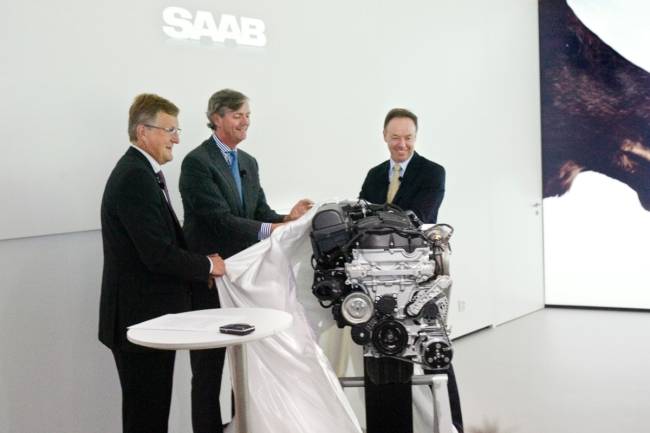
Remember back in September of last year how proud and satisfied both Saab's CEO Jan Åke Jonsson and Chairman Victor Muller were to have signed a deal with BMW to buy their 1.6L turbo petrol engine for use in the upcoming Saab 9-3 replacement?

Jan Åke Jonsson and Victor Muller of Saab and
Ian Robertson of BMW unvail the 1.6L turbo engine

If I am not mistaken, this is the engine that just won the "Engine of the year" award in the 1.4 litre - 1.8 litre class at the International Engine of the Year Awards at Engine Expo in Stuttgart! Here is the motivation for the top podium finish:

Over the past four years, BMW and PSA have won this category with their jointly developed and produced 1.6- litre turbo engine. However, in the past 12 months, BMW has launched its own, further developed version of the multiple award-winner, and it’s this powerplant that has taken the honours in 2011.

Central to this enhanced unit is the adoption of fully variable valve management. The throttle-free load control technology – based on the Valvetronic system used in other BMW engines and highly unusual in this compact segment – optimizes the engine’s responses and, at the same time, makes for a significant reduction in fuel consumption and emissions.

Within fractions of a second, the valve management adjusts the stroke and opening period of the intake valves to the amount of output required, with the camshaft acting on the valves through an additional intermediate arm, and not directly through the cam follower. The pivot point of this additional intermediate arm is infinitely adjustable by an eccentric shaft controlled by an electric motor.

The result is an engine that brings fully variable valve management, turbocharging and 120 bar petrol direct injection together for the first time in a Mini. The engine was first seen in the Countryman Cooper S and has now been rolled out across the Mini range. The fuel economy of the 184bhp motor on the EU combined cycle is around 9% better than its predecessor’s.

When it came to the judging, the new unit was up against some talented rivals. Fellow downsized turbos from Alfa Romeo and Ford both scored well in Europe, but failed to match the BMW’s consistent scoring in all regions. That could change in the future when the Alfa and Ford units are rolled out across multiple continents.

“It’s the energetic heart of one of the world’s friskiest and most funloving cars,” said jury member, Frank Markus from Motor Trend, summing up the Mini engine’s appeal.

Wednesday, May 18, 2011

Saab 9-5X rendering

I spotted this one on the Italian Saab blog SAAB news: a Saab 9-5X! Rendering is done by Theophilus Chin.


A Saab 9-5X is of course very unlikely at the moment with Saab being in a liquidity squeeze. And there would maybe not even be a market for such a niche vehicle from a niche car brand. But it looks good, doesn't it?

Check out Theophilus Chin for more car rendering.

Wednesday, May 11, 2011

Autobild with next Saab 9-3 photoshop

German Autobild believes that the next Saab 9-3 will be one of the stars of the 2011 IAA Frankfurt in September. And they have attached the following photoshop to illustrate the next 9-3.


I believe this picture may be a bit outdated now that Saab has displayed the PhoeniX concept. The real car should have a front more similar to the PhoeniX and according to yesterday's info from Vi Bilägare also a higher waistline and a higher rear end.

Furthermore, despite now both Autobild and autoevolution saying that the car will be displayed at Frankfurt, there is reason to believe that Frankfurt is a bit too early. The car is supposed to launch in the fall of 2012 and for Saab to unvail the car one year ahead of launch seems unlikely.