Yesterday Saab got new owners and from now on Saab is an electric car company. I have earlier asked how on earth Saab in the short run can manage to sell enough electric cars to turn a profit. And when the profits fail to appear, do the new owers have deep enough pockets to keep Saab alive? Now I ask who is gonna sell these cars?
Yesterday NEVS revealed that their first car, an electrified Saab 9-3, will be launched at the turn of the year 2013. That means 18 months from now. Around mid-summer 2014, NEVS expects the production at Saab to reach a considerable volume. And in the long run, the production should reach maximum capacity, which means 150,000 - 200,000 cars each year.
The main market for Saab electric vehicles will be China. China is the world's most-populous country and the world's biggest market for cars. It is also the world's third biggest country in square kilometers. And in this enourmous country, Saab has currently no presence and is a totally unknown brand. In order to make it big in China, Saab will need a well functioning distribution network and lots of dealers. And Saab needs time and lots of money to increase the brand awareness. So just who will be Saab's partner in China? Without a powerful partner, Saab does not stand a chance.
What about the US and Europe? Here Saab had a well functioning distribution network based on hundreds of dealers. Some which had been with Saab since the 50s or 60s. But this network has slowly been crumbing away for the last 2-3 years. How much of it will be left when Saab's first electric car will be launched at the turn of 2013? And do the dealers really see a future in selling only one electric Saab car each week when they used to sell one turbo Saab each day?
For now I will only ask these questions and will not try to give any answers. Mostly because I have no idea what the answers are, but also because today is only the day after NEVS bought Saab and I should probably give NEVS some time to address these issues.
But as you probably understand, I am very sceptical to NEVS and its plans for Saab. But I am open to be convinced that this is the best option for a continued Life with Saab.

A blog fueled by enthusiasm about Saab, the greatest car company between the North and the South Pole. And their cars, which probably is the only cars that would start on a cold and crispy South Pole morning.
Showing posts with label world of Arild. Show all posts
Showing posts with label world of Arild. Show all posts
Thursday, June 14, 2012
Thursday, May 31, 2012
A Japanese-Chinese electrified Saab dream - Take two
After months of uncertainty a decision on the Saab saga can come this week. But who will be the new owner of Saab and what does its plan for Saab look like?
The company that has been tipped as the favorite the last week or so is National Electric Vehicle Sweden. It is a company owned by Chinese energy corporation National Modern Energy Holdings and the Japanese risk-capital firm Sun Investment. There might also be Swedish stakeholders involved.
Back in March when we got the first word that a Japanese-Chinese consortium was interested in buying Saab and make electric vehicles, I wrote an entry titled "A Japanese-Chinese electrified Saab dream". This is take two.
National Electric Vehicle Sweden is said to only be interested in electric and hybrid cars. It plans to first launch an electric car based on the current Saab 9-3 (look to the ePower concept) while the development continue of the Saab phoenix platform to be the base for future electric and hybrid cars. Other electric vehicles might also be produced on license in the mean time.
But is this a viable business plan?
First of all, I hope the owners have deep pockets. My assertion is that no company will make any money on electric cars for years to come. Most companies won't even cover the costs of developing and manufacturing the cars.
In Western Europe and in the United States, which traditionally have been Saab's play ground, just a little over 20,000 electric cars were sold in 2011. In Western Europe 11,563 electric cars left the dealer lots. That is only a 0.09 per cent market share. In the United States only around 10,000 electric cars were sold.
You might argue that 2011 was the first year that true competitive electric cars were available, which is a good point. The sales will of course increase considerably when more and more electric cars become available, but that will also mean that the competition will get tougher and tougher.
So just how much of the electric car market is Saab going to take?
In the "good old days" before Saab's problems started in 2009, Saab had maybe around 0.25 per cent of the global car sales. It would be daring to expect that Saab would do considerably better selling electric cars. The competitors will be the same.
Gartner, the world's largest technology market research firm, in January forecasted 100,000 electric cars to be sold in 2012 in the United States. 0.25 per cent of this is only 250 cars...
If we include hybrid cars, still less than 1 million was sold in 2011. And Gartner expects less than 3 million to be sold in 2017. 0.25 per cent of 1 million is 2,500 and of 3 million is 7,500.
And remember that Saab's hybrid cars are maybe 2-3 years away from being launched. That's how much time "experts" say that Saab needs to complete the phoenix platform and launch cars.
The Trollhättan plant is scaled to produce 150,000 cars. 7,500 cars is just two weeks of production...
We know from the past year that to run Saab Automobile costs hundred of millions each month. Even if the work force is cut down to a minimum, the money will pour out. And so I repeat: I hope the owners of National Electric Vehicle Sweden have deep pockets!
And to make matters worse, National Electric Vehicle Sweden doesn't seem to care about the current Saab owners. I make this assertion based on reports that National Electric Vehicle Sweden is not interested in buying Saab Automobile Parts, the company that supply genuine spare parts to Saab cars around the world. Saab Parts is the link between Saab and the owner of older Saab cars. And National Electric Vehicle Sweden is not interested in nurturing this link.
Don't get me wrong, I am not against electric cars or hybrid cars. Saab needs both (or at least hybrid cars) in its portfolio. But the most important thing for a company like Saab is its current customers and not some future unknown customer who likes electric gadgets. We, the current loyal fans and customers, must be the fundament of the future customer base. But how on earth are National Electric Vehicle Sweden going to keep us when it doesn't even want to serve our current cars?
So National Electric Vehicle Sweden, you have a lot of work to do to convince me (and I am sure many other Saab fans as well) that you are the best future owner of Saab and that you have the financial backbone to steer Saab through meagre years and to a bright future.
The company that has been tipped as the favorite the last week or so is National Electric Vehicle Sweden. It is a company owned by Chinese energy corporation National Modern Energy Holdings and the Japanese risk-capital firm Sun Investment. There might also be Swedish stakeholders involved.
Back in March when we got the first word that a Japanese-Chinese consortium was interested in buying Saab and make electric vehicles, I wrote an entry titled "A Japanese-Chinese electrified Saab dream". This is take two.
National Electric Vehicle Sweden is said to only be interested in electric and hybrid cars. It plans to first launch an electric car based on the current Saab 9-3 (look to the ePower concept) while the development continue of the Saab phoenix platform to be the base for future electric and hybrid cars. Other electric vehicles might also be produced on license in the mean time.
But is this a viable business plan?
First of all, I hope the owners have deep pockets. My assertion is that no company will make any money on electric cars for years to come. Most companies won't even cover the costs of developing and manufacturing the cars.
In Western Europe and in the United States, which traditionally have been Saab's play ground, just a little over 20,000 electric cars were sold in 2011. In Western Europe 11,563 electric cars left the dealer lots. That is only a 0.09 per cent market share. In the United States only around 10,000 electric cars were sold.
You might argue that 2011 was the first year that true competitive electric cars were available, which is a good point. The sales will of course increase considerably when more and more electric cars become available, but that will also mean that the competition will get tougher and tougher.
So just how much of the electric car market is Saab going to take?
In the "good old days" before Saab's problems started in 2009, Saab had maybe around 0.25 per cent of the global car sales. It would be daring to expect that Saab would do considerably better selling electric cars. The competitors will be the same.
Gartner, the world's largest technology market research firm, in January forecasted 100,000 electric cars to be sold in 2012 in the United States. 0.25 per cent of this is only 250 cars...
If we include hybrid cars, still less than 1 million was sold in 2011. And Gartner expects less than 3 million to be sold in 2017. 0.25 per cent of 1 million is 2,500 and of 3 million is 7,500.
And remember that Saab's hybrid cars are maybe 2-3 years away from being launched. That's how much time "experts" say that Saab needs to complete the phoenix platform and launch cars.
The Trollhättan plant is scaled to produce 150,000 cars. 7,500 cars is just two weeks of production...
We know from the past year that to run Saab Automobile costs hundred of millions each month. Even if the work force is cut down to a minimum, the money will pour out. And so I repeat: I hope the owners of National Electric Vehicle Sweden have deep pockets!
And to make matters worse, National Electric Vehicle Sweden doesn't seem to care about the current Saab owners. I make this assertion based on reports that National Electric Vehicle Sweden is not interested in buying Saab Automobile Parts, the company that supply genuine spare parts to Saab cars around the world. Saab Parts is the link between Saab and the owner of older Saab cars. And National Electric Vehicle Sweden is not interested in nurturing this link.
Don't get me wrong, I am not against electric cars or hybrid cars. Saab needs both (or at least hybrid cars) in its portfolio. But the most important thing for a company like Saab is its current customers and not some future unknown customer who likes electric gadgets. We, the current loyal fans and customers, must be the fundament of the future customer base. But how on earth are National Electric Vehicle Sweden going to keep us when it doesn't even want to serve our current cars?
So National Electric Vehicle Sweden, you have a lot of work to do to convince me (and I am sure many other Saab fans as well) that you are the best future owner of Saab and that you have the financial backbone to steer Saab through meagre years and to a bright future.

Wednesday, May 9, 2012
Saab Sonett V4 steering wheel
I have now owned a 1968 Saab Sonett V4 for one and half week. And I have to say that I am very happy with my purchase. But there are always a few details to improve. At the moment I have laid my eyes on the steering wheel. The car has the 1969 Sonett steering wheel. It's a fairly plain black steering wheel. Three black spokes, a black center and black leather imitation. And because of the age and wear, it needs an upgrade.


What should I upgrade to? So far I have looked at British Moto-Lita steering wheels, Italian Nardi and the Saab Sport&Rally wheel. The Moto-Lita and Nardi wheels are available in both leather and wood and both black and polished rims. The Saab Sport&Rally is a leather wheel with black rims.
So what will be the most fitting to the Sonett interior? I have of course a few opinions of my own, but what do you think?


Saab Sonett V4 interior

Worn steering wheel
What should I upgrade to? So far I have looked at British Moto-Lita steering wheels, Italian Nardi and the Saab Sport&Rally wheel. The Moto-Lita and Nardi wheels are available in both leather and wood and both black and polished rims. The Saab Sport&Rally is a leather wheel with black rims.
So what will be the most fitting to the Sonett interior? I have of course a few opinions of my own, but what do you think?

Moto-Lita Leather

Moto-Lita wood

Nardi Wood with black stripe

Saab Sport&Rally
What steering wheel will look the best?
Tuesday, May 1, 2012
Last leg of my trip to buy the Sonett
Today I have traveled the last leg of my trip to buy and transport home a Saab Sonett. At seven o'clock in the morning the Hurtigrute ship arrived in Trondheim, the third largest city in Norway. Trondheim is best known for the Nidaros Cathedral, founded in 1070 on the burial ground of Saint Olaf of Norway, and a destination for pilgrims coming from all of Northern Europe.
On this early Tuesday May 1st (a public holiday in Norway) the roads were more or less deserted. I drove through the city without stopped for traffic even once. The journey took my south east and my first break was on the Dovre mountain pass.

On the top of Dovre the mountain tops were still covered in snow, but fortunately the road was dry and free of snow and ice. The weather was wonderful. Blue sky and a warming sun.

Driving over Dovre was actually a small detour. The reason for the detour was located in Grimsbu. From Dovre I drove down Folldal and came to Grimsbu. And I am very glad I made this detour, or else I wouldn't have this next picture to show you.

From the classic BP gas station in Grimsbu, I drove straight home. And after eight hours in the car, with only a handful of 10-15 minutes breaks, I have to say that I am surprised how comfortable the seats and the sitting position in the Sonett is! I am really starting to love this car. But let's talk more about the Sonett loving in a later post.
Ps: In case you wondered if the Sonett came from the two day sea journey unharmed, I'm pleased to say yes. When I went down to the car deck to get the car, the seaman at the car deck told me that they had had to moved the car a little back and forth in order to place fenders around it. Thank you Hurtigruten, for taking such good care of your goods, and of your guests as well. I promise I will return for another journey!
On this early Tuesday May 1st (a public holiday in Norway) the roads were more or less deserted. I drove through the city without stopped for traffic even once. The journey took my south east and my first break was on the Dovre mountain pass.

Dovre mountain pass
On the top of Dovre the mountain tops were still covered in snow, but fortunately the road was dry and free of snow and ice. The weather was wonderful. Blue sky and a warming sun.

Top of the mountain pass Dovre
Driving over Dovre was actually a small detour. The reason for the detour was located in Grimsbu. From Dovre I drove down Folldal and came to Grimsbu. And I am very glad I made this detour, or else I wouldn't have this next picture to show you.

Fill her up with leaded premium fuel, please
From the classic BP gas station in Grimsbu, I drove straight home. And after eight hours in the car, with only a handful of 10-15 minutes breaks, I have to say that I am surprised how comfortable the seats and the sitting position in the Sonett is! I am really starting to love this car. But let's talk more about the Sonett loving in a later post.
Ps: In case you wondered if the Sonett came from the two day sea journey unharmed, I'm pleased to say yes. When I went down to the car deck to get the car, the seaman at the car deck told me that they had had to moved the car a little back and forth in order to place fenders around it. Thank you Hurtigruten, for taking such good care of your goods, and of your guests as well. I promise I will return for another journey!
Saturday, April 28, 2012
Going north
Now I have embarked on my trip across Norway to buy myself a classic Saab. First leg is a flight from Oslo Airport to the biggest city in the north of Norway, Tromsø. But that is not my final destination. In Tromsø I will board a turbo prop plane that will take me to Andøya.
Andøya is maybe best known for its Andøya Rocket Range, where scientists from all over Europe come to see their research rockets being launched. In 1995 one of these rocket launches almost started a nuclear doomsday. For 24 minutes the Russians thought that they were under nuclear attack from the US when their radars detected a rocket. The Russians mistook the science rocket as a Trident missile from a US submarine. A Trident missile would take only 10 minutes to reach Moscow, so there were little time to investigate and identify the rocket. President Boris Yeltsin activated his "nuclear briefcase" and his generals urged Yeltsin to launch the counter attack. But Yeltsin hesitated. He couldn't believe that the West would attack Russia, and this hesitation probably saved us from a nuclear apocalypse. 24 minuted after the rocket was launched, it fell into the ocean near Spitsbergen, just as intended. And for the record, the Russians had been informed that a rocket would be launched on that day at that time, but obviously communication were not all that good in Russia. This little known incident has been said to be much more severe than the Cuban Missile Crisis.
But enough of this anecdote. Below is my travel plan the next four days.

Andøya is maybe best known for its Andøya Rocket Range, where scientists from all over Europe come to see their research rockets being launched. In 1995 one of these rocket launches almost started a nuclear doomsday. For 24 minutes the Russians thought that they were under nuclear attack from the US when their radars detected a rocket. The Russians mistook the science rocket as a Trident missile from a US submarine. A Trident missile would take only 10 minutes to reach Moscow, so there were little time to investigate and identify the rocket. President Boris Yeltsin activated his "nuclear briefcase" and his generals urged Yeltsin to launch the counter attack. But Yeltsin hesitated. He couldn't believe that the West would attack Russia, and this hesitation probably saved us from a nuclear apocalypse. 24 minuted after the rocket was launched, it fell into the ocean near Spitsbergen, just as intended. And for the record, the Russians had been informed that a rocket would be launched on that day at that time, but obviously communication were not all that good in Russia. This little known incident has been said to be much more severe than the Cuban Missile Crisis.
But enough of this anecdote. Below is my travel plan the next four days.

Friday, April 27, 2012
Roadtrip across the Arctic Circle
Tomorrow I will embark on a trip that will take me across the Arctic Circle from south to north and then back again. The mission of the trip: To buy a classic Saab!
If the technology serves me well, I will document the trip on this blog. So I invite you to come along!
Let's see if you can guess what car (a hint is on this page) I'm buying:
Be sure to stop by during the next four days to get updates on a trip involving a jet airliner, a turbo prop airliner, a classic Saab and the "World's Most Beautiful Sea Voyage".
If the technology serves me well, I will document the trip on this blog. So I invite you to come along!
Let's see if you can guess what car (a hint is on this page) I'm buying:
Be sure to stop by during the next four days to get updates on a trip involving a jet airliner, a turbo prop airliner, a classic Saab and the "World's Most Beautiful Sea Voyage".
Tuesday, March 27, 2012
A Japanese-Chinese electrified Saab dream
Last week we got the news that a Japanese-Chinese consortium is interested in acquiring the Saab bankruptcy estate to start producing electric vehicles in Trollhättan. It was reported that the electric vehicles would be produced under the Saab brand. In addition, also batteries are said to be planned for production in Trollhättan.
"They have tabled a bid and are very aggresive - it is a Japanese-Chinese consortium," a source told just-auto.
"They have serious money and are a serious competitor," the source said and continued "It's a huge consortium together with battery manufacturing - they are planning to make electric cars."
But the future for electric cars is very much disputed. Some say electric cars is a false trail, while others embrace the technology. The hard fact is that currently electric cars are just too expensive to buy and do not offer the flexibility of the fossil fuel cars. Batteries are heavy and expensive and have a limited life span, and the cars do not offer the loading space and the travel distance that fossil fuel cars do.
The acclaimed Chevy Volt/Opel Ampera (recently voted European Car of the Year) hybrid has sold so poorly (about 10,000 cars in 2011) that production was recently halted. Also last year's European Car of the Year, the electric Nissan Leaf, has sold poorly. Just a little over 20,000 Leafs left the Nissan dealer lots in 2011, and production for 2012 is only planned to 40,000 cars.
In Sweden, where the Japanese-Chinese consortium now wants to manufacture electric cars in a plant scaled at producing 150,000 cars per year, the car buyers have still to embrace electric cars. Swedish Radio reports that only 25 out of 40,000 new cars sold in January and February were electric.
In the UK, according to The Financial Times, there were only 1,000 electric cars sold last year, and in France only 2,000. In the US, in a year when auto sales were up more than 10%, sales of "alternative power source light vehicles" rose just 2.3%, according to WardsAuto. Only 18,000 electric cars (incl. plug-ins hybrids) were sold in the US in 2011 according to CleantechBlog. Gartner, the large technology market research firm, has forecasting 100,000 electric car sales in 2012 in the US. But 2012 has started slow. The Nissan Leaf only sold 1,154 in January-February and the Chevy Volt hybrid only 1,626 according to Autoblog.
The introduction of more and more electric vehicles will drive the numbers upwards, but the main problem, i.e. high prices, will remain for a long time.
A Ford Focus electric sells for $32,500 (including a $7,500 US government tax credit) and a home battery-charging unit costs a further $1,499. By comparison a petrol Ford Focus sells for $16,500.
The Guardian reports that even industry executives are not optimistic. A survey of global car executives by KPMG recently found that they do not expect electric-car sales to exceed 15% of annual global car sales before 2025. This figure is still far higher than most independent analysts offer.
So if the Japanese-Chinese consortium is successful in acquiring Saab, then maybe Saab will be an even more rare car than it is today. Maybe the Saab owners of the future will be even fewer, even more special and even more quirky than we are today.
"They have tabled a bid and are very aggresive - it is a Japanese-Chinese consortium," a source told just-auto.
"They have serious money and are a serious competitor," the source said and continued "It's a huge consortium together with battery manufacturing - they are planning to make electric cars."
But the future for electric cars is very much disputed. Some say electric cars is a false trail, while others embrace the technology. The hard fact is that currently electric cars are just too expensive to buy and do not offer the flexibility of the fossil fuel cars. Batteries are heavy and expensive and have a limited life span, and the cars do not offer the loading space and the travel distance that fossil fuel cars do.
The acclaimed Chevy Volt/Opel Ampera (recently voted European Car of the Year) hybrid has sold so poorly (about 10,000 cars in 2011) that production was recently halted. Also last year's European Car of the Year, the electric Nissan Leaf, has sold poorly. Just a little over 20,000 Leafs left the Nissan dealer lots in 2011, and production for 2012 is only planned to 40,000 cars.
In Sweden, where the Japanese-Chinese consortium now wants to manufacture electric cars in a plant scaled at producing 150,000 cars per year, the car buyers have still to embrace electric cars. Swedish Radio reports that only 25 out of 40,000 new cars sold in January and February were electric.
In the UK, according to The Financial Times, there were only 1,000 electric cars sold last year, and in France only 2,000. In the US, in a year when auto sales were up more than 10%, sales of "alternative power source light vehicles" rose just 2.3%, according to WardsAuto. Only 18,000 electric cars (incl. plug-ins hybrids) were sold in the US in 2011 according to CleantechBlog. Gartner, the large technology market research firm, has forecasting 100,000 electric car sales in 2012 in the US. But 2012 has started slow. The Nissan Leaf only sold 1,154 in January-February and the Chevy Volt hybrid only 1,626 according to Autoblog.
The introduction of more and more electric vehicles will drive the numbers upwards, but the main problem, i.e. high prices, will remain for a long time.
A Ford Focus electric sells for $32,500 (including a $7,500 US government tax credit) and a home battery-charging unit costs a further $1,499. By comparison a petrol Ford Focus sells for $16,500.
The Guardian reports that even industry executives are not optimistic. A survey of global car executives by KPMG recently found that they do not expect electric-car sales to exceed 15% of annual global car sales before 2025. This figure is still far higher than most independent analysts offer.
So if the Japanese-Chinese consortium is successful in acquiring Saab, then maybe Saab will be an even more rare car than it is today. Maybe the Saab owners of the future will be even fewer, even more special and even more quirky than we are today.
Sunday, February 5, 2012
Youngman only credible option for survival for Saab
For a few weeks now we have read that Chinese Zhejiang Youngman Lotus Automobile, Turkish Brightwell Holdings and Indian Mahindra & Mahindra all want to buy the entire Saab business. The bankruptcy administrators have said that four to five parties are interested in buying Saab in its entirety. The question is how serious these suitors are and if their plans are credible.
On Friday Turkish Brigtwell repeated, this time to just-auto, that they are in negotiations with GM to reach an agreement to license GM technology should Brightwell get Saab. This despite GM's definite statement January 20th that GM will not license its technology to any buyer of Saab. But Brightwell keeps claiming that its in discussions with GM. To just-auto on Friday Brightwell also said that with some "minor adjustments" production could restart immediately in Trollhättan should Brightwell succeed in acquiring Saab.
This begs the question if Brightwell is just naive or totally ridiculous? First of all, GM has said that no buyer of Saab will be licensed technology to produce the Saab 9-5 or be supplied the Saab 9-4X.
"We are not in discussions with anyone regarding Saab and we will not license technology to any buyer," GM spokesman James Cain said to SvD.
At the very same time Brightwell claimed that it was in negotiations with GM.
In addition to this Brightwell now says that it can restart Saab immediately.
Jan Åke Jonsson and his team of experienced Saab managers and workers used months to restart Saab after Spyker acquired the company in February 2010. Saab wasn't up and running properly until summer 2010. Now Jonsson has retired, Gunnar Brunius, who was Vice President Purchasing & Manufacturing has started working at Volvo Aero. Even the man who replaced Brunius, Göran Ejbyfeldt, has left and will be head of quality and IT at Västra Götalandsregionen. I am sure many other key people have gotten new jobs as wel, so an immediate restart of Saab is impossible, and such a statement only shows us how inexperienced and naive Brightwell must be.
I am sorry to say this, but Brightwell Holdings sounds like another Spyker. Big words, big plans, no reality check (Ps: I am forever grateful to Spyker for saving Saab last time!). And so I conclude that Brightwell is no option for Saab.
Then what about Mahindra & Mahindra? We know little about them so far. They have made no official statements to the media. From media reports we can at least assume that Mahindra is interested and that they have been in Trollhättan. But what are they interested in?
According to Svenska Dagbladet, which cites several sources, Mahindra is only interested in starting a production center in Europe for its electric cars. Which would indicate that Mahindra isn't interested in the Saab brand, the Saab cars, the Saab development or the Saab technology. Mahindra probably just want tools, machinery, production lines and a few hundred experienced workers.
Apart from Brightwell and Mahindra, companies like Semcon, Beijing Automotive, Volvo Cars and many others are drooling over parts of the Saab bankruptcy estate.
Which leaves us with Youngman as the only known and credible suitor which wants Saab in its entirety. Brand, technology, cars, engineers, sales network, tools, machinery, workers. Everything.
Youngman has already place a bid. A bid that has not been accepted. And that is understandable when reports say that the bid was SEK 2.2 - 3.2 billion. Saab is worth more than that if sold in parts. So Youngman needs to increase its bid. And let's hope they do, because neither Brigtwell nor Mahindra seem to be a credible solution for Saab.
On Friday Turkish Brigtwell repeated, this time to just-auto, that they are in negotiations with GM to reach an agreement to license GM technology should Brightwell get Saab. This despite GM's definite statement January 20th that GM will not license its technology to any buyer of Saab. But Brightwell keeps claiming that its in discussions with GM. To just-auto on Friday Brightwell also said that with some "minor adjustments" production could restart immediately in Trollhättan should Brightwell succeed in acquiring Saab.
This begs the question if Brightwell is just naive or totally ridiculous? First of all, GM has said that no buyer of Saab will be licensed technology to produce the Saab 9-5 or be supplied the Saab 9-4X.
"We are not in discussions with anyone regarding Saab and we will not license technology to any buyer," GM spokesman James Cain said to SvD.
At the very same time Brightwell claimed that it was in negotiations with GM.
In addition to this Brightwell now says that it can restart Saab immediately.
Jan Åke Jonsson and his team of experienced Saab managers and workers used months to restart Saab after Spyker acquired the company in February 2010. Saab wasn't up and running properly until summer 2010. Now Jonsson has retired, Gunnar Brunius, who was Vice President Purchasing & Manufacturing has started working at Volvo Aero. Even the man who replaced Brunius, Göran Ejbyfeldt, has left and will be head of quality and IT at Västra Götalandsregionen. I am sure many other key people have gotten new jobs as wel, so an immediate restart of Saab is impossible, and such a statement only shows us how inexperienced and naive Brightwell must be.
I am sorry to say this, but Brightwell Holdings sounds like another Spyker. Big words, big plans, no reality check (Ps: I am forever grateful to Spyker for saving Saab last time!). And so I conclude that Brightwell is no option for Saab.
Then what about Mahindra & Mahindra? We know little about them so far. They have made no official statements to the media. From media reports we can at least assume that Mahindra is interested and that they have been in Trollhättan. But what are they interested in?
According to Svenska Dagbladet, which cites several sources, Mahindra is only interested in starting a production center in Europe for its electric cars. Which would indicate that Mahindra isn't interested in the Saab brand, the Saab cars, the Saab development or the Saab technology. Mahindra probably just want tools, machinery, production lines and a few hundred experienced workers.
Apart from Brightwell and Mahindra, companies like Semcon, Beijing Automotive, Volvo Cars and many others are drooling over parts of the Saab bankruptcy estate.
Which leaves us with Youngman as the only known and credible suitor which wants Saab in its entirety. Brand, technology, cars, engineers, sales network, tools, machinery, workers. Everything.
Youngman has already place a bid. A bid that has not been accepted. And that is understandable when reports say that the bid was SEK 2.2 - 3.2 billion. Saab is worth more than that if sold in parts. So Youngman needs to increase its bid. And let's hope they do, because neither Brigtwell nor Mahindra seem to be a credible solution for Saab.
Monday, December 19, 2011
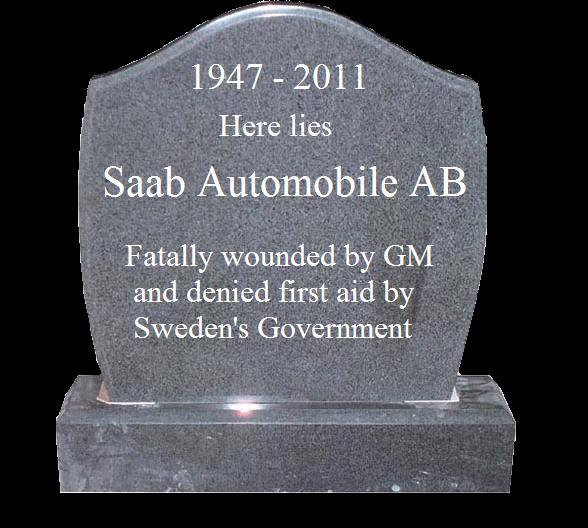
Saab died three years ago
Today will be remembered as the day the car brand Saab died. But don't let anyone fool you. Saab died more than three years ago in an office thousands of miles away from Trollhättan.
The Saab car division was established after WW2 when Saab needed to find new products to produce and sell. Saab was originally a war plane developer and manufacturer and when the war was over the company needed one more leg to stand on. After experimenting with a few other products, the company developed its first car, the UrSaab in 1947.
From there on Saab was a car company. The first car to hit the market was the Saab 92 in 1949. A two door aerodynamically shaped car with a two cylinder two stroke engine and front wheel drive. It was a small revolution in the car world. Saab improved the car year by year and during the 1950s and 1960s Saab became a victorious car brand in rally competitions.
Saab was always an engineer driven company and did not always do what was the financially best option. It was all about the cars, and the founder and car guy Marcus "Dodde" Wallenberg made sure that the development of the Saab cars could continue despite financial statements written in red.
In 1977 Saab shocked the world by introducing the Saab 99 Turbo. The world's first family car with a reliable turbo powered engine and sports car performance. A few years later the Saab 99 was developed into the Saab 900 which saw to it that Saab turned into a successful company with record sales and nice profits.
Then at the end of the 1980s things started to look difficult. Saab needed new and modern platforms to develop new cars and partners to share the costs. At the end of 1989 Saab-Scania was in the last stage of selling the car division to Fiat. Then General Motors showed up. GM had just lost Jaguar to Ford and was desperate to buy an European premium car brand. In the eleventh hour GM bought Saab, without any thoughts about what it wanted to do with the brand.
Unfortunately GM never paid much attention to its odd Swedish car brand and even worse, instead of giving Saab the needed money to develop a competitive car portfolio, it found it better to use that money to cover the yearly losses.
When GM itself was on the brink of bankruptcy in 2008, the company decided to clean up its car brand portfolio. And in that office thousands of miles away from Trollhättan it was decided that Saab would have to go. And if GM could not have Saab, no one else would either.
And so every other week we could read in the news yet another GM executive putting Saab down. Saying that the brand was a disaster. It never had made money. Saab had lost piles of money year after year. Saab would never be a success, etc etc. Was that the way to sell an asset? Would you describe the house you are selling as full of ants, mold infested and falling to pieces? Of course not! If you are serious about selling, you keep your mouth shut if you have nothing good to say! Just look at how elegantly Ford sold Volvo.
GM was (unfortunately) saved by the tax payers of the USA. The biggest car company in the world was itself in need of charity and good will from some one bigger than itself. Charity and good will it decided in 2008 that it was not willing to show Saab.
To GM big surprise several parties turned out to be interested in buying Saab. As mentioned already, GM did all it could to discourage any buyers, but the lure of the Saab brand was stronger than the warnings from GM.
Among the twenty or so parties interested, there was Geely, which was the second biggest automaker in China. We also had a financially powerful US company called Renco Group, which among other things produced the Humvee military vehicle. There was even a tiny Swedish super car company called Koenigsegg.
In June 2009, to much surprise, GM announced that it was negotiating with Koenigsegg Group. A consortium spun from the small Swedish company producing the Koenigsegg sports car. GM had chosen not to negotiate with Renco Group and Chinese Geely (which ended up buying Volvo), despite their offers being better than the one from Koenigsegg.
Why did GM chose tiny Koenigsegg? For at least two reasons. First, the company was too small to constitute any threat to GM in the future. Secondly, because GM did not believe the deal would be followed through. It was all an act by GM to have an alibi when people later would look for someone to blame when Saab was to be liquidated. Then GM could say that it had tried to sell Saab without luck.
In November tiny Koenigsegg gave up just like GM had foreseen. And GM announced that Saab would be liquidated, all according to plan.
But something happen that screwed up GM's plan. An even tinier Dutch company called Spyker Cars entered the field. And this company had a tenacious CEO that never gave up. Spyker handed in bid after bid and at the same time the pressure from fans and press became too much even for GM.
And in February 2010 GM sold Saab Automobile to tiny Spyker Cars. But GM had at least avoided selling Saab to a competitor, and had added several clauses in the deal with the buyer Spyker Cars which said that GM would have to approve any future changes in the ownership of Saab.
Not surprisingly, Saab soon ran into financial problems. It turned out to be harder than expected to rebuild the brand. A brand GM had damaged almost beyond repair with all the negative comments from the GM executives during 2009. Saab's CEO and Chairman Victor Muller then negotiated a deal with China's and the world's biggest car distributor Pang Da and the upper class coach builder Youngman. This was a fantastic deal. A deal that had the potential of making Saab an important player in China, the world's biggest market.
But GM did not like this deal. China had overtaken the US as GM's biggest market. If there was something GM did not need, it was another premium competitor in China. Especially one that could produce high quality cars locally and distribute them through the biggest dealer network in the country. And so GM decided that if Saab finalized any deals with the Chinese, GM would stop supplying Saab with technology and cars.
Saab had been developing its own vehicle architecture since 2008. But this architecture was still 1 – 2 years from market launch. And in the mean time Saab was totally dependant on GM's technology. GM knew this and insisted that it could not supply Saab with technology should Saab's deals with China be finalized.
Don't let GM or anyone else fool you. This was never about protecting technology. This was all about protecting its market share in China. The technology Saab uses in the Saab 9-3 is old (pre 2003) and has not been unique for several years. The technology Saab uses in the Saab 9-5 is still unique, but within two or three years even this technology will be widespread. And the Chinese would need at least two or three years to make use of this technology in their own vehicles. And that is assuming that they would "steal" the technology, which is an outrageous assumption in the first place.
And so the company which crawled to Washington D.C., went down on its knees and begged for mercy and money to be saved from bankruptcy and extinction, held the axe that killed Saab. The mercy GM was shown in 2009, it could not pass on to Saab.
And so Saab did not die today. Saab died three years ago by the hands of GM.

The Saab car division was established after WW2 when Saab needed to find new products to produce and sell. Saab was originally a war plane developer and manufacturer and when the war was over the company needed one more leg to stand on. After experimenting with a few other products, the company developed its first car, the UrSaab in 1947.
From there on Saab was a car company. The first car to hit the market was the Saab 92 in 1949. A two door aerodynamically shaped car with a two cylinder two stroke engine and front wheel drive. It was a small revolution in the car world. Saab improved the car year by year and during the 1950s and 1960s Saab became a victorious car brand in rally competitions.
Saab was always an engineer driven company and did not always do what was the financially best option. It was all about the cars, and the founder and car guy Marcus "Dodde" Wallenberg made sure that the development of the Saab cars could continue despite financial statements written in red.
In 1977 Saab shocked the world by introducing the Saab 99 Turbo. The world's first family car with a reliable turbo powered engine and sports car performance. A few years later the Saab 99 was developed into the Saab 900 which saw to it that Saab turned into a successful company with record sales and nice profits.
Then at the end of the 1980s things started to look difficult. Saab needed new and modern platforms to develop new cars and partners to share the costs. At the end of 1989 Saab-Scania was in the last stage of selling the car division to Fiat. Then General Motors showed up. GM had just lost Jaguar to Ford and was desperate to buy an European premium car brand. In the eleventh hour GM bought Saab, without any thoughts about what it wanted to do with the brand.
Unfortunately GM never paid much attention to its odd Swedish car brand and even worse, instead of giving Saab the needed money to develop a competitive car portfolio, it found it better to use that money to cover the yearly losses.
When GM itself was on the brink of bankruptcy in 2008, the company decided to clean up its car brand portfolio. And in that office thousands of miles away from Trollhättan it was decided that Saab would have to go. And if GM could not have Saab, no one else would either.
And so every other week we could read in the news yet another GM executive putting Saab down. Saying that the brand was a disaster. It never had made money. Saab had lost piles of money year after year. Saab would never be a success, etc etc. Was that the way to sell an asset? Would you describe the house you are selling as full of ants, mold infested and falling to pieces? Of course not! If you are serious about selling, you keep your mouth shut if you have nothing good to say! Just look at how elegantly Ford sold Volvo.
GM was (unfortunately) saved by the tax payers of the USA. The biggest car company in the world was itself in need of charity and good will from some one bigger than itself. Charity and good will it decided in 2008 that it was not willing to show Saab.
To GM big surprise several parties turned out to be interested in buying Saab. As mentioned already, GM did all it could to discourage any buyers, but the lure of the Saab brand was stronger than the warnings from GM.
Among the twenty or so parties interested, there was Geely, which was the second biggest automaker in China. We also had a financially powerful US company called Renco Group, which among other things produced the Humvee military vehicle. There was even a tiny Swedish super car company called Koenigsegg.
In June 2009, to much surprise, GM announced that it was negotiating with Koenigsegg Group. A consortium spun from the small Swedish company producing the Koenigsegg sports car. GM had chosen not to negotiate with Renco Group and Chinese Geely (which ended up buying Volvo), despite their offers being better than the one from Koenigsegg.
Why did GM chose tiny Koenigsegg? For at least two reasons. First, the company was too small to constitute any threat to GM in the future. Secondly, because GM did not believe the deal would be followed through. It was all an act by GM to have an alibi when people later would look for someone to blame when Saab was to be liquidated. Then GM could say that it had tried to sell Saab without luck.
In November tiny Koenigsegg gave up just like GM had foreseen. And GM announced that Saab would be liquidated, all according to plan.
But something happen that screwed up GM's plan. An even tinier Dutch company called Spyker Cars entered the field. And this company had a tenacious CEO that never gave up. Spyker handed in bid after bid and at the same time the pressure from fans and press became too much even for GM.
And in February 2010 GM sold Saab Automobile to tiny Spyker Cars. But GM had at least avoided selling Saab to a competitor, and had added several clauses in the deal with the buyer Spyker Cars which said that GM would have to approve any future changes in the ownership of Saab.
Not surprisingly, Saab soon ran into financial problems. It turned out to be harder than expected to rebuild the brand. A brand GM had damaged almost beyond repair with all the negative comments from the GM executives during 2009. Saab's CEO and Chairman Victor Muller then negotiated a deal with China's and the world's biggest car distributor Pang Da and the upper class coach builder Youngman. This was a fantastic deal. A deal that had the potential of making Saab an important player in China, the world's biggest market.
But GM did not like this deal. China had overtaken the US as GM's biggest market. If there was something GM did not need, it was another premium competitor in China. Especially one that could produce high quality cars locally and distribute them through the biggest dealer network in the country. And so GM decided that if Saab finalized any deals with the Chinese, GM would stop supplying Saab with technology and cars.
Saab had been developing its own vehicle architecture since 2008. But this architecture was still 1 – 2 years from market launch. And in the mean time Saab was totally dependant on GM's technology. GM knew this and insisted that it could not supply Saab with technology should Saab's deals with China be finalized.
Don't let GM or anyone else fool you. This was never about protecting technology. This was all about protecting its market share in China. The technology Saab uses in the Saab 9-3 is old (pre 2003) and has not been unique for several years. The technology Saab uses in the Saab 9-5 is still unique, but within two or three years even this technology will be widespread. And the Chinese would need at least two or three years to make use of this technology in their own vehicles. And that is assuming that they would "steal" the technology, which is an outrageous assumption in the first place.
And so the company which crawled to Washington D.C., went down on its knees and begged for mercy and money to be saved from bankruptcy and extinction, held the axe that killed Saab. The mercy GM was shown in 2009, it could not pass on to Saab.
And so Saab did not die today. Saab died three years ago by the hands of GM.
Monday, November 7, 2011
Victor Muller, a scheming businessman?
I went for a walk, I cooled down and I started thinking.
This is purely speculation on my part. But here is one man's view of what has happened the past couple of months.
Let's rewind to July. Swedish Automobile enters into an agreement with Pang Da and Youngman for the sale of shares that will make the Chinese owners of 53.9 percent of Swedish Automobile and thus Saab. Everybody is happy. Months pass by, General Motors makes no statement about revoking license agreements. But somewhere down the line the Chinese become unhappy with the deal. We can safely assume that both Victor Muller and the Chinese are scheming businessmen. Saab is in big financial problems. And the Pangs become greedy.
 The Chinese propose that they buy all of Saab for SEK 200 million. Victor Muller is furious:
"It was totally unacceptable. Not only because of the amount, but also because of the conditions. Everything but the return of the Messiah was on the list of conditions that would have to be met in order for them to pay. So we would never have seen any money."
Muller even said that General Motors would never approve such a deal:
"If the Chinese are to take such a large stake in Saab it would violate all regulations with GM, BMW, the EIB and the National Debt Office. It simply would not be approved, it would simply mean the end of Saab," Muller told TTELA.
Victor Muller is reluctant to sell. But the court appointed administrator, Guy Lofalk, wants to end the reconstruction if Saab isn't sold, and this will mean that Saab will face its creditors and bankruptcy filing. And Saab is out of money. Without any money, Saab will go bankrupt and Victor Muller will lose everything. How can he both keep a stake in Saab and get Saab the needed funds to survive?
The Chinese and Lofalk won't listen to reason. And so Victor Muller and the Chinese negotiate a sale. The price is increased to EUR 100 million. But have the unacceptable conditions changed? And will GM accept the sale? Victor Muller doesn't think so, but he agrees to sell. Saab needs money. The Chinese are willing to offer a EUR 50 million bridge funding to save Saab through October and maybe even November and December. Saab will live another two or three months!
Now the sunk cost for the Chinese has increased with EUR 50 million (i.e. if it has been paid). Pang Da has already paid EUR 45 million for cars to be delivered in the future. The Chinese sunk cost is now EUR 95 million. That is almost the same as the purchase price!
When the deal to sell 100 percent of Saab to the Chinese is announced, Victor Muller warns that General Motors may not like the deal. And indirectly he tells GM it is okay if it doesn't accept the deal. And he is right. The General doesn't accept the deal. Just as Muller told both the Chinese and the whole world. We can't blame GM, and Muller certainly doesn't, after all he said it would end this way.
And then what? Now maybe the Chinese realize that they can't have Saab for themselves. Victor Muller and Swedish Automobile can not be brushed aside. The Chinese are about to lose EUR 95 million and not to mention their faces. But there can still be a happy outcome. There is still the agreement from July where the Chinese take a 53.9 stake and Victor Muller and the shareholders of Swedish Automobile keep the rest. And so they will agree to meet for new negotiations?
It is of course bold of me to suggest that all that have happened the last month or two has been part of Victor Muller's strategy, or more precisly that he has used the opportunity to raise short term funding for Saab, buy time and at the same keep a stake in the company. But as I already mentioned, Victor Muller is a scheming businessman...
Ps: By using the word scheming I do not mean to suggest that anyone has done anything illegal or immoral.
This is purely speculation on my part. But here is one man's view of what has happened the past couple of months.
Let's rewind to July. Swedish Automobile enters into an agreement with Pang Da and Youngman for the sale of shares that will make the Chinese owners of 53.9 percent of Swedish Automobile and thus Saab. Everybody is happy. Months pass by, General Motors makes no statement about revoking license agreements. But somewhere down the line the Chinese become unhappy with the deal. We can safely assume that both Victor Muller and the Chinese are scheming businessmen. Saab is in big financial problems. And the Pangs become greedy.

"It was totally unacceptable. Not only because of the amount, but also because of the conditions. Everything but the return of the Messiah was on the list of conditions that would have to be met in order for them to pay. So we would never have seen any money."
Muller even said that General Motors would never approve such a deal:
"If the Chinese are to take such a large stake in Saab it would violate all regulations with GM, BMW, the EIB and the National Debt Office. It simply would not be approved, it would simply mean the end of Saab," Muller told TTELA.
Victor Muller is reluctant to sell. But the court appointed administrator, Guy Lofalk, wants to end the reconstruction if Saab isn't sold, and this will mean that Saab will face its creditors and bankruptcy filing. And Saab is out of money. Without any money, Saab will go bankrupt and Victor Muller will lose everything. How can he both keep a stake in Saab and get Saab the needed funds to survive?
The Chinese and Lofalk won't listen to reason. And so Victor Muller and the Chinese negotiate a sale. The price is increased to EUR 100 million. But have the unacceptable conditions changed? And will GM accept the sale? Victor Muller doesn't think so, but he agrees to sell. Saab needs money. The Chinese are willing to offer a EUR 50 million bridge funding to save Saab through October and maybe even November and December. Saab will live another two or three months!
Now the sunk cost for the Chinese has increased with EUR 50 million (i.e. if it has been paid). Pang Da has already paid EUR 45 million for cars to be delivered in the future. The Chinese sunk cost is now EUR 95 million. That is almost the same as the purchase price!
When the deal to sell 100 percent of Saab to the Chinese is announced, Victor Muller warns that General Motors may not like the deal. And indirectly he tells GM it is okay if it doesn't accept the deal. And he is right. The General doesn't accept the deal. Just as Muller told both the Chinese and the whole world. We can't blame GM, and Muller certainly doesn't, after all he said it would end this way.
And then what? Now maybe the Chinese realize that they can't have Saab for themselves. Victor Muller and Swedish Automobile can not be brushed aside. The Chinese are about to lose EUR 95 million and not to mention their faces. But there can still be a happy outcome. There is still the agreement from July where the Chinese take a 53.9 stake and Victor Muller and the shareholders of Swedish Automobile keep the rest. And so they will agree to meet for new negotiations?
It is of course bold of me to suggest that all that have happened the last month or two has been part of Victor Muller's strategy, or more precisly that he has used the opportunity to raise short term funding for Saab, buy time and at the same keep a stake in the company. But as I already mentioned, Victor Muller is a scheming businessman...
Ps: By using the word scheming I do not mean to suggest that anyone has done anything illegal or immoral.
Friday, October 28, 2011
Will the stakeholders approve the deal?
Here are the different stakeholders which can stop the sale of Saab from Swedish Automobile to Chinese companies Youngman and Pang Da.
Shareholders of Swedish Automobile
Swedish Automobile N.V. is a public limited company (Naamloze Vennootschap) with a number of shares traded freely on the Euronext stock exchange.
European Investment Bank (EIB)
The European Investment Bank, which so far has loaned Saab EUR 217 million to Saab's research and development projects for greener and safer vehicles.
Sweden's Government
Has guaranteed Saab's loan in the EIB. The task of securing the loan guarantee has been delegated to Sweden's National Debt Office.
Sweden's National Debt Office (NDO)
Has guaranteed the EIB loan by taking most of Saab's tangible assets as collateral, like the spare parts company, the property company and the tools company. The NDO's task is to ensure that Sweden does not suffer any loss by guaranteeing the EIB loan.
BMW
BMW has agreed to sell engines to the next generation Saab 9-3. From comments made by Victor Muller et al. one can assume that the engine deal has conditions bound to who has ownership of Saab.
General Motors (GM)
Saab's previous owner which still owns redeemable preference shares in Saab and also is owner of much of the technology Saab is using.
China's National Development and Reform Commission (NDRC)
China's top economic planning body. Must approve any Chinese investment abroad and foreign investments in China.
Other Chinese government agencies
There are also a handful of other Chinese government agencies which needs to approve different steps of the deal, like the transfer of money from China to abroad.
Will the stakeholders approve the deal?
The shareholders of Swedish Automobile will probably not oppose the deal as long as the alternative is bankruptcy in Saab, which would mean that the value of the SWAN shares would be zero.
The EIB, the NDO and the Sweden's Government will probably not oppose an ownership change as long as Saab stays a Swedish company and the new owners have the required financial muscles.
Now that the Chinese take full ownership of Saab, it is more likely that the NDRC will approve the deal. And there has already been news reports saying that they are positive to the deal. The other Chinese agencies are not considered obstacles once the NDRC has given its approval.
It is difficult to know if BMW will oppose the deal. But BMW has a small role, so far it has agreed only to sell one type of engine, the 1.6 liter turbo petrol engine. So BMW will probably not oppose. And if BMW does, it may not bring down the deal anyway.
The hardest nut to crack is GM. It is a fact that all three current models from Saab, the 9-3, the 9-5 and the 9-4X are based on GM technology. Earlier GM has been terrified that its technology would find its way to China. But a lot has changed the last two years. Ford has sold Volvo to China and GM has been through a Chapter 11 bankruptcy and gotten new management. GM has also spent two more years establishing Buick in China and now has a strong position with strong partners over there. So one might hope that GM's position has changed and the company will approve the sale?
Shareholders of Swedish Automobile
Swedish Automobile N.V. is a public limited company (Naamloze Vennootschap) with a number of shares traded freely on the Euronext stock exchange.
European Investment Bank (EIB)
The European Investment Bank, which so far has loaned Saab EUR 217 million to Saab's research and development projects for greener and safer vehicles.
Sweden's Government
Has guaranteed Saab's loan in the EIB. The task of securing the loan guarantee has been delegated to Sweden's National Debt Office.
Sweden's National Debt Office (NDO)
Has guaranteed the EIB loan by taking most of Saab's tangible assets as collateral, like the spare parts company, the property company and the tools company. The NDO's task is to ensure that Sweden does not suffer any loss by guaranteeing the EIB loan.
BMW
BMW has agreed to sell engines to the next generation Saab 9-3. From comments made by Victor Muller et al. one can assume that the engine deal has conditions bound to who has ownership of Saab.
General Motors (GM)
Saab's previous owner which still owns redeemable preference shares in Saab and also is owner of much of the technology Saab is using.
China's National Development and Reform Commission (NDRC)
China's top economic planning body. Must approve any Chinese investment abroad and foreign investments in China.
Other Chinese government agencies
There are also a handful of other Chinese government agencies which needs to approve different steps of the deal, like the transfer of money from China to abroad.
Will the stakeholders approve the deal?
The shareholders of Swedish Automobile will probably not oppose the deal as long as the alternative is bankruptcy in Saab, which would mean that the value of the SWAN shares would be zero.
The EIB, the NDO and the Sweden's Government will probably not oppose an ownership change as long as Saab stays a Swedish company and the new owners have the required financial muscles.
Now that the Chinese take full ownership of Saab, it is more likely that the NDRC will approve the deal. And there has already been news reports saying that they are positive to the deal. The other Chinese agencies are not considered obstacles once the NDRC has given its approval.
It is difficult to know if BMW will oppose the deal. But BMW has a small role, so far it has agreed only to sell one type of engine, the 1.6 liter turbo petrol engine. So BMW will probably not oppose. And if BMW does, it may not bring down the deal anyway.
The hardest nut to crack is GM. It is a fact that all three current models from Saab, the 9-3, the 9-5 and the 9-4X are based on GM technology. Earlier GM has been terrified that its technology would find its way to China. But a lot has changed the last two years. Ford has sold Volvo to China and GM has been through a Chapter 11 bankruptcy and gotten new management. GM has also spent two more years establishing Buick in China and now has a strong position with strong partners over there. So one might hope that GM's position has changed and the company will approve the sale?
Thursday, October 20, 2011
Saab best European car when looking at vehicle fire
Last winter there were a couple of incidents where new Saab 9-5's caught fire. The Swedish car magazine Teknikens Värld mentioned these incidents in December of last year:
I have not read how the workshops or insurance companies concluded after investigating the two fires.
But anyway, let's get to the main point of this post: How often does a Saab catch on fire compared to other car makes?
To answer this question I turn to the Norwegian insurance company Gjensidige Forsikring. They have collected statistics of car insurance cases concerning vehicle fire.
Source: Gjensidige Forsikring, table published by VG.
The figures are an average from 2008 and 2009. The statistics are based on makes with at least 12 reported fires during the two years.
From the table we can read that 16 out of 10,000 Saab cars catch on fire each year in Norway. That is more seldom than the average, which is 20 out of 10,000 cars. The average for Norway is the same as for the UK, which could indicate that the statistics for Norway is transferable to other European countries with the same car makes and models.
Furthermore, Saab is the best European car. Only five Japanese makes and one Korean make do better. Compared to Saab's premium competitors, Saab is better than Volvo and a lot better than BMW. Mercedes-Benz and Audi can't even compete!
Conclusion: Yet another good reason to be satisfied with choosing Saab!
Two new Saab 9-5 is burned in a short time
In a short time, two new Saab 9-5 have caught fire in the engine compartment, and both incidents occurred in Linköping. No people were harmed.

On Friday a new Saab 9-5 (pictured above) began to burn while driving in Linköping. The fire in the car, which was test drive car, started in the engine compartment (note the hole in the hood). This was reported by Östgöta Correspondenten. The driver managed to drive the car to the side and call the emergency services which came and extinguished the fire. No people were injured.
The fire is not the first that has occurred in a new Saab 9-5. Shortly before Friday's incident another fire occurred, reportedly also this one in the engine compartment and even here it was in Linköping. No people were harmed.
According to unconfirmed information, Friday's fire occurred in a 9-5 BioPower while the other fire occured in a fully equipped 9-5 Aero XWD Turbo6. It has been mentioned that the two cars were equipped with retrofitted electric engine block heaters of various types and makes, but it is unknown if these were the cause of the fires.
According to an anonymous tip to teknikensvarld.se, the two block heaters which were used are not approved by Saab. Which may seem a bit strange considering that one of the cars was a Saab dealer test drive car.
I have not read how the workshops or insurance companies concluded after investigating the two fires.
But anyway, let's get to the main point of this post: How often does a Saab catch on fire compared to other car makes?
To answer this question I turn to the Norwegian insurance company Gjensidige Forsikring. They have collected statistics of car insurance cases concerning vehicle fire.
| Car make | Fires per 10,000 vehicles per year |
| CHEVROLET | 49 |
| CHRYSLER | 36 |
| RENAULT | 32 |
| MERCEDES-BENZ | 32 |
| AUDI | 31 |
| CITROEN | 27 |
| BMW | 25 |
| PEUGEOT | 23 |
| OPEL | 22 |
| VW | 20 |
| FORD | 20 |
| VOLVO | 19 |
| NISSAN | 19 |
| SAAB | 16 |
| SUZUKI | 16 |
| MITSUBISHI | 15 |
| HONDA | 15 |
| MAZDA | 13 |
| HYUNDAI | 11 |
| TOYOTA | 7 |
| All makes | 20 |
The figures are an average from 2008 and 2009. The statistics are based on makes with at least 12 reported fires during the two years.
From the table we can read that 16 out of 10,000 Saab cars catch on fire each year in Norway. That is more seldom than the average, which is 20 out of 10,000 cars. The average for Norway is the same as for the UK, which could indicate that the statistics for Norway is transferable to other European countries with the same car makes and models.
Furthermore, Saab is the best European car. Only five Japanese makes and one Korean make do better. Compared to Saab's premium competitors, Saab is better than Volvo and a lot better than BMW. Mercedes-Benz and Audi can't even compete!
Conclusion: Yet another good reason to be satisfied with choosing Saab!
Tuesday, October 18, 2011
What's going on with Saab now?
I bet many of you are wondering what is going on right now with Saab. And I am too.
What I assume is that at Saab in Trollhättan they are working hard on the efficiency plan Cheetah. And also preparing for the creditors meeting on October 31. In addition, I bet they are working hard to get Youngman and Pang Da approved as new part owners by all stakeholders, including General Motors, the European Investment Bank, The Swedish Government and their National Debt Office. And of course also with they Chinese stakeholders with the National Development and Reform Commission in the forefront. And that is probably what both Youngman and Pang Da are busy doing too: Convincing the NDRC that the investments in Saab's parent company is a good idea.
I do not know when to expect any news from China and the NDRC. But I would think that Saab wants some good news to bring to the creditors' meeting October 31.
What I assume is that at Saab in Trollhättan they are working hard on the efficiency plan Cheetah. And also preparing for the creditors meeting on October 31. In addition, I bet they are working hard to get Youngman and Pang Da approved as new part owners by all stakeholders, including General Motors, the European Investment Bank, The Swedish Government and their National Debt Office. And of course also with they Chinese stakeholders with the National Development and Reform Commission in the forefront. And that is probably what both Youngman and Pang Da are busy doing too: Convincing the NDRC that the investments in Saab's parent company is a good idea.
I do not know when to expect any news from China and the NDRC. But I would think that Saab wants some good news to bring to the creditors' meeting October 31.
Thursday, October 6, 2011
Det finns inga älgar i Japan
It is a well known fact that the Swedish car manufacturers Saab and Volvo have been the only manufacturers to have carried out crash tests with elk/moose. Reason being that the woods of the Nordic countries are crowded with elk. A report from 2005 suggested that there were 100,000 elk in Norway, 250,000-300,000 in Sweden and 113,000- 125,000 in Finland.

In Sweden alone there are more than 7,000 collisions each year between car and elk and a number of these end up with human injury. Since the elk has a big and heavy body and long legs, it can be very dangerous to hit one. When hitting the elk with the front of the car at a high speed, the elk's legs will fold and the body will hit the windshield and the front of the roof construction. Just imagine how much damage 700 kg can do when hitting the windshield at 80 km/h!

Now the Swedish insurance company Folksam has examined collisons between elk and car and written a report.
The Folksam examination has looked at all collisons between elk and car which have been reported to the company between 1995 and 2010. In addition to this material, the company has looked at in depth studies carried out by the Swedish Transport Administration (Trafikverket) on fatal accidents, as well as carried out 5 crash tests with a crash test dummy elk on different car models.
Folksam found that when the speed exceeds 80 km/h, cars have trouble withstanding a collison with an elk. Even though the forces of the crash is relatively minor, the body of the elk will often deform the cars windshield and roof severely and lead to human injury. The car manufacturers therefore needs to work hard on reducing the speed of the vehicles by developing good auto brake systems and improve the construction of the roof of the car.
The most critical situation is when the roof is teared open or pushed down or when the elk enters the cabin of the car. 90 per cent of the people who were severely injured or killed were driving on roads with speed limits 80 km/h or higher. The share of people injuries was 14 per cent higher for people travelling in small cars compared to those travelling in large cars.
But now finally let's get to the point of all this: In cars from Volvo and Saab the injured people had less risk of severe injury compared to people in other car brands and comparable sized models. The risk of getting severely injured was actually 25 lower in a Volvo or Saab than in other brands and comparable sized cars.
Percentage of people with injury, who have a high * risk of medical disability
* At least 8% risk of disability
From the table above we can read that Saab is noticeable better than the German cars and a lot better than the Japanese cars.
Folksam also examined if there were any coherence between a high score in the Euro NCAP test (4 or 5 stars) and the car's ability to protects its passengers when hitting an elk. No coherence could be found. But there was a difference between Swedish made cars and other cars of similar size. A find that indicates that Saab and Volvo have developed a roof construction that reduce the risk of deformation.

Saab performing elk crash test on a Saab 900

Nordic elk, weighs from 300 kg to 700 kg and can be more than two meters tall
In Sweden alone there are more than 7,000 collisions each year between car and elk and a number of these end up with human injury. Since the elk has a big and heavy body and long legs, it can be very dangerous to hit one. When hitting the elk with the front of the car at a high speed, the elk's legs will fold and the body will hit the windshield and the front of the roof construction. Just imagine how much damage 700 kg can do when hitting the windshield at 80 km/h!

Now the Swedish insurance company Folksam has examined collisons between elk and car and written a report.
The Folksam examination has looked at all collisons between elk and car which have been reported to the company between 1995 and 2010. In addition to this material, the company has looked at in depth studies carried out by the Swedish Transport Administration (Trafikverket) on fatal accidents, as well as carried out 5 crash tests with a crash test dummy elk on different car models.
Folksam found that when the speed exceeds 80 km/h, cars have trouble withstanding a collison with an elk. Even though the forces of the crash is relatively minor, the body of the elk will often deform the cars windshield and roof severely and lead to human injury. The car manufacturers therefore needs to work hard on reducing the speed of the vehicles by developing good auto brake systems and improve the construction of the roof of the car.
The most critical situation is when the roof is teared open or pushed down or when the elk enters the cabin of the car. 90 per cent of the people who were severely injured or killed were driving on roads with speed limits 80 km/h or higher. The share of people injuries was 14 per cent higher for people travelling in small cars compared to those travelling in large cars.
But now finally let's get to the point of all this: In cars from Volvo and Saab the injured people had less risk of severe injury compared to people in other car brands and comparable sized models. The risk of getting severely injured was actually 25 lower in a Volvo or Saab than in other brands and comparable sized cars.
Percentage of people with injury, who have a high * risk of medical disability
Saab and Volvo | 57 % |
Audi, BMW, Mercedes Benz and Opel | 69 % |
Toyota, Nissan, Mitsubishi, Honda and Mazda | 75 % |
Other brands | 71 % |
All not Swedish made | 72 % |
* At least 8% risk of disability
From the table above we can read that Saab is noticeable better than the German cars and a lot better than the Japanese cars.
Folksam also examined if there were any coherence between a high score in the Euro NCAP test (4 or 5 stars) and the car's ability to protects its passengers when hitting an elk. No coherence could be found. But there was a difference between Swedish made cars and other cars of similar size. A find that indicates that Saab and Volvo have developed a roof construction that reduce the risk of deformation.
Saab performing elk crash test on a Saab 900
Conclusion: The myth lives on. If you worry about crashing with large animals, then buy Swedish!
Or to say it like an old Swedish slogan: Det finns inga älgar i Japan! (There are no elks in Japan).
Or to say it like an old Swedish slogan: Det finns inga älgar i Japan! (There are no elks in Japan).
Sunday, October 2, 2011
12 month celebration
In September this blog celebrated one year of existence. The first six months the blog was strictly about owning a new Saab 9-5. Then in March of this year I had more or less run out of things to write about the 9-5 and at the same time I wanted to write about Saab in general. When Swade announced that he would stop writing SaabsUnited it made my decision easy and this blog changed name from "Life with the new Saab 9-5" to "Life with Saab".
Writing this blog for the past 12 months has been a lot of fun. It has seldom felt like hard work or a chore. This post is entry number 583. I have no idea how many words I have written, but it must be in the thousands.
The most popular posts have been:
The blog has attracted visitors from 110 different countries. The top 10 countries from which my readers come visiting are the following:

I am proud to say that many a time this blog has been the first English speaking blog/news provider to break big news. And a few times this blog was actually even ahead of the Swedish news providers too.
The most common search phrases that have directed visitors from search engines to my blog are:
But all this would of course be no fun without knowing that you, my readers, are out there. So a big thank you to all of you!
Writing this blog for the past 12 months has been a lot of fun. It has seldom felt like hard work or a chore. This post is entry number 583. I have no idea how many words I have written, but it must be in the thousands.
The most popular posts have been:
- Night panel
- The Saab 9-5 colors
- My owner's review of the new Saab 9-5
- Future Saab cars - Phoenix architecture
- Winter review of the Saab 9-5 Sedan
- The development of the new Saab 9-5
- A recap of the upcoming Saab 9-3 replacement
The blog has attracted visitors from 110 different countries. The top 10 countries from which my readers come visiting are the following:

I am proud to say that many a time this blog has been the first English speaking blog/news provider to break big news. And a few times this blog was actually even ahead of the Swedish news providers too.
The most common search phrases that have directed visitors from search engines to my blog are:
- "life with saab"
- "saab news"
- "saab"
- "latest saab news"
But all this would of course be no fun without knowing that you, my readers, are out there. So a big thank you to all of you!
Tuesday, September 27, 2011
Saab among cheapest to repair
The Swedish insurance company Länsförsäkring has just released a report with statistics over breakdown of machinery covered by insurances taken out at Länsförsäkring. The survey is done on the basis of 10,328 reported breakdowns. For anyone interested in statistics and cars, the report is very interesting!
Let's first look at the overall view.

Saab is better than the average car and better than the premium brands and competitors Jaguar, Audi, BMW, Alfa Romeo and Cadillac. Only two European brands, Mercedes and Volvo, are better than Saab, in addition to many Asian brands.
Let's go deeper into the numbers.
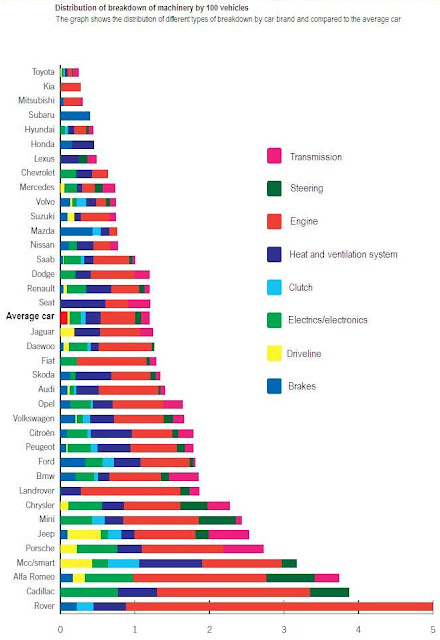
Here we can see that Saab's breakdowns are mostly connected to engine and electrics/electronics and to some degree the heat and ventilation system. And if we dig even deeper into Saab's electrics/electronics breakdown, the report says that a repeated problem for the Saab 9-3 with a diesel engine has been the generator (alternator, dynamo), which according to the report can indicate a problem with the construction. Furhermore, many of the engine breakdowns are due to the Saab 9-5 having a repeated problem with the turbo. The risk of getting a problem with the turbo is five times bigger in a Saab 9-5 than the average car with a turbo.
Then let's look at the average cost of repairing the breakdown.

The graph shows that in Sweden Saab is among the absolute cheapest cars to repair if it breaks down. The average cost of repairing a breakdown on a Saab costs only approx. SEK 11,000, while repairing Volvo costs approx SEK 12,500, a Mercedes or a BMW approx SEK 18,000 and an Audi approx SEK 20,000.
And finally, I am happy to report that no Saab is among the 20 car models with the highest breakdown frequency. But on the list we can find models from Alfa Romeo, BMW, Landrover, Volkswagen and Porsche among others.
Let's first look at the overall view.

Saab is better than the average car and better than the premium brands and competitors Jaguar, Audi, BMW, Alfa Romeo and Cadillac. Only two European brands, Mercedes and Volvo, are better than Saab, in addition to many Asian brands.
Let's go deeper into the numbers.

Here we can see that Saab's breakdowns are mostly connected to engine and electrics/electronics and to some degree the heat and ventilation system. And if we dig even deeper into Saab's electrics/electronics breakdown, the report says that a repeated problem for the Saab 9-3 with a diesel engine has been the generator (alternator, dynamo), which according to the report can indicate a problem with the construction. Furhermore, many of the engine breakdowns are due to the Saab 9-5 having a repeated problem with the turbo. The risk of getting a problem with the turbo is five times bigger in a Saab 9-5 than the average car with a turbo.
Then let's look at the average cost of repairing the breakdown.

The graph shows that in Sweden Saab is among the absolute cheapest cars to repair if it breaks down. The average cost of repairing a breakdown on a Saab costs only approx. SEK 11,000, while repairing Volvo costs approx SEK 12,500, a Mercedes or a BMW approx SEK 18,000 and an Audi approx SEK 20,000.
And finally, I am happy to report that no Saab is among the 20 car models with the highest breakdown frequency. But on the list we can find models from Alfa Romeo, BMW, Landrover, Volkswagen and Porsche among others.
Wednesday, September 21, 2011
Saab enters into reconstruction, but then what?
Earlier today the Court of Appeal for Western Sweden ruled that Saab Automobile AB, Saab Automobile Tools AB and Saab Automobile Powertrain AB would be allowed to enter a voluntary reconstruction. According to the court, this was not an easy decision, and one of the judges did in fact not agree. In the court's ruling, the court does to a large degree support Saab's point of view that the District Court went far beyond what the law requires when assessing Saab's possibility to go through a successful reconstruction. According to the Court of Appeal, the investment planned by Chinese Youngman and Pang Da of SEK 2.2 billion, should be enough to restart production and thus be reason to allow a reconstruction.
Later today Vänersborg District Court appointed Guy Lofalk to be the administrator of the reconstruction. Lofalk was also the administrator when Saab went through a reconstruction in 2009 and was Saab preferred administrator also this time.
Now that Saab enters into reconstruction, all bankruptcy filings and the collection of debt done by the Swedish Debt Enforcement Agency will be stopped. Either Saab sorts out these issues during the reconstruction, or Saab will have to face them again once the company exits reconstruction. The expectation is of course that these issues are sorted out.
The problem for Saab the past months have been to get enough money to make wage payments and also to get enough money to pay suppliers and restart production.
Let's look at the wage payments first. Now during the reconstruction the wages will be paid by the Swedish state. That means that Saab will not have to use its money on wage payments. But Saab must repay the Swedish state at a later point, so it is in fact just a "loan". But nonetheless, it means that Saab can use its current money and resources on focusing on paying suppliers and restarting production.
Saab has announced that the company now will "launched an efficiency improvement initiative as part of a broader review of the company's business plan for 2012 and beyond". And writes that "headcount reductions cannot be ruled out". A reconstruction allows the company to reduce the number of employees, as well as ask for a write down of debt. Saab has said earlier that it aims at fully pay its suppliers, but a reduction of workers is now not ruled out.
And restarting production must be the number one priority. To generate incomes, Saab needs to produce and sell cars. On 31 October Saab will meet its creditors and present the plan for continued life. It is the administrator and the creditors who shall assess if it is probable that Saab can get through this ordeal. If they can not see a future for Saab, then the reconstruction will be ended and Saab will once again face bankruptcy filings. On the other hand, if they decide that there is a future for Saab, then an agreement which let's Saab restart production is needed. Saab has said earlier that it can pay 25 per cent of the debt outstanding to the suppliers now, and the remaining in November when the Chinese investments are expected to be finalized.
A reconstruction can last for several months, and can be extended with three months each time, but can never last more than one year. It is expected that Saab will keep the reconstruction as short as possible. Which probably means that the company will want to exit reconstruction as soon as the investments from Youngman and Pang Da have been finalized and a restart in production is set.
But be aware that the Chinese investments and Saab's survival still depends on China's National Development and Reform Commission (NDRC), China's top economic planning body, approving the investments from Youngman and Pang Da. An approval that is expected in the beginning of November.
Later today Vänersborg District Court appointed Guy Lofalk to be the administrator of the reconstruction. Lofalk was also the administrator when Saab went through a reconstruction in 2009 and was Saab preferred administrator also this time.
Now that Saab enters into reconstruction, all bankruptcy filings and the collection of debt done by the Swedish Debt Enforcement Agency will be stopped. Either Saab sorts out these issues during the reconstruction, or Saab will have to face them again once the company exits reconstruction. The expectation is of course that these issues are sorted out.
The problem for Saab the past months have been to get enough money to make wage payments and also to get enough money to pay suppliers and restart production.
Let's look at the wage payments first. Now during the reconstruction the wages will be paid by the Swedish state. That means that Saab will not have to use its money on wage payments. But Saab must repay the Swedish state at a later point, so it is in fact just a "loan". But nonetheless, it means that Saab can use its current money and resources on focusing on paying suppliers and restarting production.
Saab has announced that the company now will "launched an efficiency improvement initiative as part of a broader review of the company's business plan for 2012 and beyond". And writes that "headcount reductions cannot be ruled out". A reconstruction allows the company to reduce the number of employees, as well as ask for a write down of debt. Saab has said earlier that it aims at fully pay its suppliers, but a reduction of workers is now not ruled out.
And restarting production must be the number one priority. To generate incomes, Saab needs to produce and sell cars. On 31 October Saab will meet its creditors and present the plan for continued life. It is the administrator and the creditors who shall assess if it is probable that Saab can get through this ordeal. If they can not see a future for Saab, then the reconstruction will be ended and Saab will once again face bankruptcy filings. On the other hand, if they decide that there is a future for Saab, then an agreement which let's Saab restart production is needed. Saab has said earlier that it can pay 25 per cent of the debt outstanding to the suppliers now, and the remaining in November when the Chinese investments are expected to be finalized.
A reconstruction can last for several months, and can be extended with three months each time, but can never last more than one year. It is expected that Saab will keep the reconstruction as short as possible. Which probably means that the company will want to exit reconstruction as soon as the investments from Youngman and Pang Da have been finalized and a restart in production is set.
But be aware that the Chinese investments and Saab's survival still depends on China's National Development and Reform Commission (NDRC), China's top economic planning body, approving the investments from Youngman and Pang Da. An approval that is expected in the beginning of November.
Tuesday, September 6, 2011
Bankruptcy is not an option
It looks like Saab is in its conclusive days. These are the days that may decide if Saab is to be or not to be. We can't rule out the possibility that Saab can raise the money needed to pay wages and thus prolong the turmoil another fourth night when the September wages are due. But what if they can't raise the money?
One option that has been mentioned to protect the company from creditors if money can't be raised in time is a reconstruction. An option I do not believe in.
Others say that a bankruptcy would be the best option and it would not necessarily mean the end of Saab. But the way I see it a bankruptcy would definitely mean the end of Saab as we know it.
From earlier we know that it is not possible to buy the Saab brand name and the Gripen logo without buying the whole company. So if Saab is to continue after a bankruptcy, someone needs to buy the whole company. But what will the company produce? All three current models (9-3, 9-5, 9-4X) are fully based on technology design and developed under GM or technology sourced from GM.
When Swedish Automobile bought Saab from GM they made contracts by the hundred to regulate and secure the use of GM technology. If Saab and Swedish Automobile go bankrupt, all these contracts will most likely be void. If someone wants to buy Saab and restart production, that someone must make new contracts with GM.
But will GM be willing to make these contracts again? And will GM be willing if the buyer is Chinese or Russian? Or another possible future competitor? Probably not.
And so bankruptcy is no option. A bankruptcy would be the end and not the start of new Saab.
To save Saab the only option is to raise money.
One option that has been mentioned to protect the company from creditors if money can't be raised in time is a reconstruction. An option I do not believe in.
Others say that a bankruptcy would be the best option and it would not necessarily mean the end of Saab. But the way I see it a bankruptcy would definitely mean the end of Saab as we know it.
From earlier we know that it is not possible to buy the Saab brand name and the Gripen logo without buying the whole company. So if Saab is to continue after a bankruptcy, someone needs to buy the whole company. But what will the company produce? All three current models (9-3, 9-5, 9-4X) are fully based on technology design and developed under GM or technology sourced from GM.
When Swedish Automobile bought Saab from GM they made contracts by the hundred to regulate and secure the use of GM technology. If Saab and Swedish Automobile go bankrupt, all these contracts will most likely be void. If someone wants to buy Saab and restart production, that someone must make new contracts with GM.
But will GM be willing to make these contracts again? And will GM be willing if the buyer is Chinese or Russian? Or another possible future competitor? Probably not.
And so bankruptcy is no option. A bankruptcy would be the end and not the start of new Saab.
To save Saab the only option is to raise money.
Friday, August 26, 2011
Another reconstruction?
Update: Mats Fägerhag , Vice President Vehicle Product Development at Saab, denies the reports that Saab is preparing to file for a reconstruction.
"We have not taken any decision to apply for a reconstruction," Mats Fägerhag told TT. When asked if this is an option Saab is considering, Fägerhag said: "We're not working on that option now. I can not say that the option will not be considered later. Nothing can be ruled out, but we are not working on a application for a reconstruction now."
Update II: Saab's parent company, Swedish Automobile, has now issued a press release that neither denies nor confirms that Saab is planning for a reconstruction. It says that all available options will be evaluated.
To Bloomberg Eric Geers, Executive Director of Communication at Saab said: "We're still focusing on securing financing, but in order to ensure the continued security of Saab, we remain open to all available options."
Earlier today Swedish radio claimed that the management of Saab is, as one option, preparing to apply for a reconstruction of the company. That means that the company will go to the court and ask to be allowed to start a process where the organization of the company and the debt of the company may be restructured. For the court to allow for this to take place, there must be a viable future for the company.
A reconstruction would mean that Saab would be allowed to reorganize and/or reduce the workforce and most importantly, ask for debt settlement proceedings and thus write down of debt. But for this to happen, a mayority of the creditors must approve the write down of debt.
The debt is most likely much less now than it was back in 2009 when Saab went through its first reconstruction. Estimates earlier this summer said that the debt to suppliers could be SEK 1 billion. When Saab went through a reconstruction in 2009, the debt was around SEK 11 billion. Most of the debt, around SEK 8 billion was to GM, and the rest which would be around SEK 3 billion was to other and smaller suppliers. Of the SEK 11 billion, 75 per cent or SEK 8.3 billion was written down.
This time around much less debt would need to be written down, maybe less than SEK 1 billion. But much of this would still need to be done on the expense of smaller suppliers which also saw their money claims being written down just two years ago. These small suppliers may still depend on Saab and would maybe once again accept a write down. But what about the bigger foreign suppliers, suppliers which do not depend on Saab, will they once again be willing to help Saab? Will GM, which probably still is Saab's biggest supplier, be willing to help Saab once more?
And how does the European Investment Bank (EIB) fit in? Will the EUR 217 million loan given by the EIB to Saab be part of the proceedings? And why on earth would they accept a write down when they have fullproof securities in the guarantees from the Swedish Government?
Under the current circumstances I am a bit doubtful that a reconstruction will be allowed by the court and if it is, I am also doubtful if the creditors will accept a write down of debt. The last time Saab went through a reconstruction, both the court and most suppliers believed in a future for the company. Now, after low sales and huge losses, the confidence in a future for Saab may have been lost. And especially among the foreign suppliers and the EIB.
In other words, I don't really consider a reconstruction as a possible option. I still believe in Saab and a future for Saab, but that future needs to the funded by investors and not suppliers.
If the reports that the management is preparing to file for reconstruction are factual, then I assume we will get more information in the hours and days to come.
"We have not taken any decision to apply for a reconstruction," Mats Fägerhag told TT. When asked if this is an option Saab is considering, Fägerhag said: "We're not working on that option now. I can not say that the option will not be considered later. Nothing can be ruled out, but we are not working on a application for a reconstruction now."
Update II: Saab's parent company, Swedish Automobile, has now issued a press release that neither denies nor confirms that Saab is planning for a reconstruction. It says that all available options will be evaluated.
To Bloomberg Eric Geers, Executive Director of Communication at Saab said: "We're still focusing on securing financing, but in order to ensure the continued security of Saab, we remain open to all available options."
Earlier today Swedish radio claimed that the management of Saab is, as one option, preparing to apply for a reconstruction of the company. That means that the company will go to the court and ask to be allowed to start a process where the organization of the company and the debt of the company may be restructured. For the court to allow for this to take place, there must be a viable future for the company.
A reconstruction would mean that Saab would be allowed to reorganize and/or reduce the workforce and most importantly, ask for debt settlement proceedings and thus write down of debt. But for this to happen, a mayority of the creditors must approve the write down of debt.
The debt is most likely much less now than it was back in 2009 when Saab went through its first reconstruction. Estimates earlier this summer said that the debt to suppliers could be SEK 1 billion. When Saab went through a reconstruction in 2009, the debt was around SEK 11 billion. Most of the debt, around SEK 8 billion was to GM, and the rest which would be around SEK 3 billion was to other and smaller suppliers. Of the SEK 11 billion, 75 per cent or SEK 8.3 billion was written down.
This time around much less debt would need to be written down, maybe less than SEK 1 billion. But much of this would still need to be done on the expense of smaller suppliers which also saw their money claims being written down just two years ago. These small suppliers may still depend on Saab and would maybe once again accept a write down. But what about the bigger foreign suppliers, suppliers which do not depend on Saab, will they once again be willing to help Saab? Will GM, which probably still is Saab's biggest supplier, be willing to help Saab once more?
And how does the European Investment Bank (EIB) fit in? Will the EUR 217 million loan given by the EIB to Saab be part of the proceedings? And why on earth would they accept a write down when they have fullproof securities in the guarantees from the Swedish Government?
Under the current circumstances I am a bit doubtful that a reconstruction will be allowed by the court and if it is, I am also doubtful if the creditors will accept a write down of debt. The last time Saab went through a reconstruction, both the court and most suppliers believed in a future for the company. Now, after low sales and huge losses, the confidence in a future for Saab may have been lost. And especially among the foreign suppliers and the EIB.
In other words, I don't really consider a reconstruction as a possible option. I still believe in Saab and a future for Saab, but that future needs to the funded by investors and not suppliers.
If the reports that the management is preparing to file for reconstruction are factual, then I assume we will get more information in the hours and days to come.
Subscribe to:
Posts (Atom)