If the Saab brand is not miraculously saved, then I guess this will be the last update on sales of new Saab cars.
Sweden
According to Bil Sweden, there were 18 new Saab cars registered in Sweden in December, compared to 1,111 cars in December of 2010. For the year 2011 as a whole, 3,482 new Saabs have been registered in Sweden, compared to 8,683 the previous year.
USA
According to Automotive News, 270 new Saab cars were sold in the USA in December 2011, compared to 1,074 the previous year. For 2011 as a whole, 5,610 Saabs were sold, up 3 percent from 5,446 in 2010.
UK
According to SMMT, there were 8 new Saabs registered in the UK in December, compared to 750 in December 2010. For the year as a whole, 4,138 new Saabs were registered, compared to 5,898 the previous year.
Norway
TBA
Ireland
TBA

A blog fueled by enthusiasm about Saab, the greatest car company between the North and the South Pole. And their cars, which probably is the only cars that would start on a cold and crispy South Pole morning.
Showing posts with label Statistics. Show all posts
Showing posts with label Statistics. Show all posts
Monday, January 2, 2012
Thursday, October 20, 2011
Saab best European car when looking at vehicle fire
Last winter there were a couple of incidents where new Saab 9-5's caught fire. The Swedish car magazine Teknikens Värld mentioned these incidents in December of last year:
I have not read how the workshops or insurance companies concluded after investigating the two fires.
But anyway, let's get to the main point of this post: How often does a Saab catch on fire compared to other car makes?
To answer this question I turn to the Norwegian insurance company Gjensidige Forsikring. They have collected statistics of car insurance cases concerning vehicle fire.
Source: Gjensidige Forsikring, table published by VG.
The figures are an average from 2008 and 2009. The statistics are based on makes with at least 12 reported fires during the two years.
From the table we can read that 16 out of 10,000 Saab cars catch on fire each year in Norway. That is more seldom than the average, which is 20 out of 10,000 cars. The average for Norway is the same as for the UK, which could indicate that the statistics for Norway is transferable to other European countries with the same car makes and models.
Furthermore, Saab is the best European car. Only five Japanese makes and one Korean make do better. Compared to Saab's premium competitors, Saab is better than Volvo and a lot better than BMW. Mercedes-Benz and Audi can't even compete!
Conclusion: Yet another good reason to be satisfied with choosing Saab!
Two new Saab 9-5 is burned in a short time
In a short time, two new Saab 9-5 have caught fire in the engine compartment, and both incidents occurred in Linköping. No people were harmed.

On Friday a new Saab 9-5 (pictured above) began to burn while driving in Linköping. The fire in the car, which was test drive car, started in the engine compartment (note the hole in the hood). This was reported by Östgöta Correspondenten. The driver managed to drive the car to the side and call the emergency services which came and extinguished the fire. No people were injured.
The fire is not the first that has occurred in a new Saab 9-5. Shortly before Friday's incident another fire occurred, reportedly also this one in the engine compartment and even here it was in Linköping. No people were harmed.
According to unconfirmed information, Friday's fire occurred in a 9-5 BioPower while the other fire occured in a fully equipped 9-5 Aero XWD Turbo6. It has been mentioned that the two cars were equipped with retrofitted electric engine block heaters of various types and makes, but it is unknown if these were the cause of the fires.
According to an anonymous tip to teknikensvarld.se, the two block heaters which were used are not approved by Saab. Which may seem a bit strange considering that one of the cars was a Saab dealer test drive car.
I have not read how the workshops or insurance companies concluded after investigating the two fires.
But anyway, let's get to the main point of this post: How often does a Saab catch on fire compared to other car makes?
To answer this question I turn to the Norwegian insurance company Gjensidige Forsikring. They have collected statistics of car insurance cases concerning vehicle fire.
| Car make | Fires per 10,000 vehicles per year |
| CHEVROLET | 49 |
| CHRYSLER | 36 |
| RENAULT | 32 |
| MERCEDES-BENZ | 32 |
| AUDI | 31 |
| CITROEN | 27 |
| BMW | 25 |
| PEUGEOT | 23 |
| OPEL | 22 |
| VW | 20 |
| FORD | 20 |
| VOLVO | 19 |
| NISSAN | 19 |
| SAAB | 16 |
| SUZUKI | 16 |
| MITSUBISHI | 15 |
| HONDA | 15 |
| MAZDA | 13 |
| HYUNDAI | 11 |
| TOYOTA | 7 |
| All makes | 20 |
The figures are an average from 2008 and 2009. The statistics are based on makes with at least 12 reported fires during the two years.
From the table we can read that 16 out of 10,000 Saab cars catch on fire each year in Norway. That is more seldom than the average, which is 20 out of 10,000 cars. The average for Norway is the same as for the UK, which could indicate that the statistics for Norway is transferable to other European countries with the same car makes and models.
Furthermore, Saab is the best European car. Only five Japanese makes and one Korean make do better. Compared to Saab's premium competitors, Saab is better than Volvo and a lot better than BMW. Mercedes-Benz and Audi can't even compete!
Conclusion: Yet another good reason to be satisfied with choosing Saab!

Monday, October 17, 2011
Saab is third most common car in Sweden
Here is some interesting statistics from Sweden, the home of Saab and Volvo. In many countries around the world both Saab and Volvo may be seen as premium and even luxary cars and those two car brands make up only a small fraction of all the cars on the roads. But not so in Sweden. In Sweden these two car brands are among the most common cars. Anyone who has been to Sweden will have seen this and if you've been to Trollhättan you have probably gotten a Saab overdose. But let's look at the statistics.
Ten most common car brands in Sweden 2010
There little doubt that Volvo is Sweden's biggest car brand with more than double the number of cars on the road than the runner up which is Volkswagen. On third is Saab, but there is almost three times as many Volvos as there are Saabs on the road.
The same statistics, this time presented in a chart:

But is there any difference between men and women in Sweden?
If we look at statistics from 2005, we can see that men prefer Volvo first and then Saab and Volkswagen. When we look at women, they prefer Volvo first and then Volkswagen, Ford, Toyota and in fifth place Saab.
 Source: Statistics Sweden
So does this mean that Saab is first and foremost a car for Swedish men?
Ten most common car brands in Sweden 2010
Brand | On the road | Inactive | Total |
VOLVO | 996 958 | 237 193 | 1 234 151 |
VOLKSWAGEN | 437 254 | 100 629 | 537 883 |
SAAB | 343 522 | 80 308 | 423 830 |
TOYOTA | 281 037 | 44 109 | 325 146 |
FORD | 277 272 | 82 834 | 360 106 |
AUDI | 214 762 | 43 773 | 258 535 |
RENAULT | 177 107 | 24 108 | 201 215 |
OPEL | 176 908 | 56 275 | 233 183 |
PEUGEOT | 163 362 | 25 286 | 188 648 |
BMW | 153 464 | 47 545 | 201 009 |
There little doubt that Volvo is Sweden's biggest car brand with more than double the number of cars on the road than the runner up which is Volkswagen. On third is Saab, but there is almost three times as many Volvos as there are Saabs on the road.
The same statistics, this time presented in a chart:

But is there any difference between men and women in Sweden?
If we look at statistics from 2005, we can see that men prefer Volvo first and then Saab and Volkswagen. When we look at women, they prefer Volvo first and then Volkswagen, Ford, Toyota and in fifth place Saab.

So does this mean that Saab is first and foremost a car for Swedish men?
Thursday, October 6, 2011
Det finns inga älgar i Japan
It is a well known fact that the Swedish car manufacturers Saab and Volvo have been the only manufacturers to have carried out crash tests with elk/moose. Reason being that the woods of the Nordic countries are crowded with elk. A report from 2005 suggested that there were 100,000 elk in Norway, 250,000-300,000 in Sweden and 113,000- 125,000 in Finland.

In Sweden alone there are more than 7,000 collisions each year between car and elk and a number of these end up with human injury. Since the elk has a big and heavy body and long legs, it can be very dangerous to hit one. When hitting the elk with the front of the car at a high speed, the elk's legs will fold and the body will hit the windshield and the front of the roof construction. Just imagine how much damage 700 kg can do when hitting the windshield at 80 km/h!

Now the Swedish insurance company Folksam has examined collisons between elk and car and written a report.
The Folksam examination has looked at all collisons between elk and car which have been reported to the company between 1995 and 2010. In addition to this material, the company has looked at in depth studies carried out by the Swedish Transport Administration (Trafikverket) on fatal accidents, as well as carried out 5 crash tests with a crash test dummy elk on different car models.
Folksam found that when the speed exceeds 80 km/h, cars have trouble withstanding a collison with an elk. Even though the forces of the crash is relatively minor, the body of the elk will often deform the cars windshield and roof severely and lead to human injury. The car manufacturers therefore needs to work hard on reducing the speed of the vehicles by developing good auto brake systems and improve the construction of the roof of the car.
The most critical situation is when the roof is teared open or pushed down or when the elk enters the cabin of the car. 90 per cent of the people who were severely injured or killed were driving on roads with speed limits 80 km/h or higher. The share of people injuries was 14 per cent higher for people travelling in small cars compared to those travelling in large cars.
But now finally let's get to the point of all this: In cars from Volvo and Saab the injured people had less risk of severe injury compared to people in other car brands and comparable sized models. The risk of getting severely injured was actually 25 lower in a Volvo or Saab than in other brands and comparable sized cars.
Percentage of people with injury, who have a high * risk of medical disability
* At least 8% risk of disability
From the table above we can read that Saab is noticeable better than the German cars and a lot better than the Japanese cars.
Folksam also examined if there were any coherence between a high score in the Euro NCAP test (4 or 5 stars) and the car's ability to protects its passengers when hitting an elk. No coherence could be found. But there was a difference between Swedish made cars and other cars of similar size. A find that indicates that Saab and Volvo have developed a roof construction that reduce the risk of deformation.

Saab performing elk crash test on a Saab 900

Nordic elk, weighs from 300 kg to 700 kg and can be more than two meters tall
In Sweden alone there are more than 7,000 collisions each year between car and elk and a number of these end up with human injury. Since the elk has a big and heavy body and long legs, it can be very dangerous to hit one. When hitting the elk with the front of the car at a high speed, the elk's legs will fold and the body will hit the windshield and the front of the roof construction. Just imagine how much damage 700 kg can do when hitting the windshield at 80 km/h!

Now the Swedish insurance company Folksam has examined collisons between elk and car and written a report.
The Folksam examination has looked at all collisons between elk and car which have been reported to the company between 1995 and 2010. In addition to this material, the company has looked at in depth studies carried out by the Swedish Transport Administration (Trafikverket) on fatal accidents, as well as carried out 5 crash tests with a crash test dummy elk on different car models.
Folksam found that when the speed exceeds 80 km/h, cars have trouble withstanding a collison with an elk. Even though the forces of the crash is relatively minor, the body of the elk will often deform the cars windshield and roof severely and lead to human injury. The car manufacturers therefore needs to work hard on reducing the speed of the vehicles by developing good auto brake systems and improve the construction of the roof of the car.
The most critical situation is when the roof is teared open or pushed down or when the elk enters the cabin of the car. 90 per cent of the people who were severely injured or killed were driving on roads with speed limits 80 km/h or higher. The share of people injuries was 14 per cent higher for people travelling in small cars compared to those travelling in large cars.
But now finally let's get to the point of all this: In cars from Volvo and Saab the injured people had less risk of severe injury compared to people in other car brands and comparable sized models. The risk of getting severely injured was actually 25 lower in a Volvo or Saab than in other brands and comparable sized cars.
Percentage of people with injury, who have a high * risk of medical disability
Saab and Volvo | 57 % |
Audi, BMW, Mercedes Benz and Opel | 69 % |
Toyota, Nissan, Mitsubishi, Honda and Mazda | 75 % |
Other brands | 71 % |
All not Swedish made | 72 % |
* At least 8% risk of disability
From the table above we can read that Saab is noticeable better than the German cars and a lot better than the Japanese cars.
Folksam also examined if there were any coherence between a high score in the Euro NCAP test (4 or 5 stars) and the car's ability to protects its passengers when hitting an elk. No coherence could be found. But there was a difference between Swedish made cars and other cars of similar size. A find that indicates that Saab and Volvo have developed a roof construction that reduce the risk of deformation.
Saab performing elk crash test on a Saab 900
Conclusion: The myth lives on. If you worry about crashing with large animals, then buy Swedish!
Or to say it like an old Swedish slogan: Det finns inga älgar i Japan! (There are no elks in Japan).
Or to say it like an old Swedish slogan: Det finns inga älgar i Japan! (There are no elks in Japan).
Tuesday, September 27, 2011
Saab among cheapest to repair
The Swedish insurance company Länsförsäkring has just released a report with statistics over breakdown of machinery covered by insurances taken out at Länsförsäkring. The survey is done on the basis of 10,328 reported breakdowns. For anyone interested in statistics and cars, the report is very interesting!
Let's first look at the overall view.

Saab is better than the average car and better than the premium brands and competitors Jaguar, Audi, BMW, Alfa Romeo and Cadillac. Only two European brands, Mercedes and Volvo, are better than Saab, in addition to many Asian brands.
Let's go deeper into the numbers.
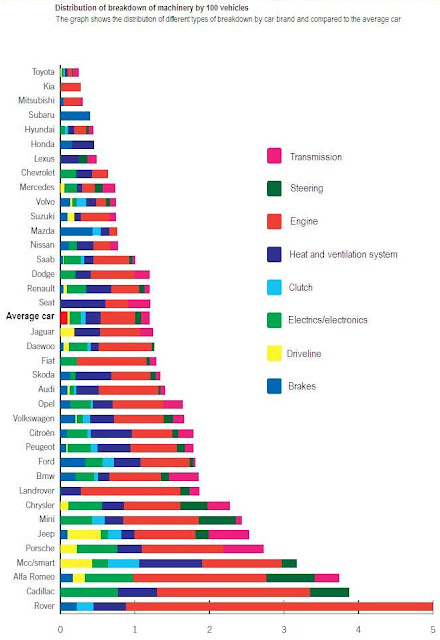
Here we can see that Saab's breakdowns are mostly connected to engine and electrics/electronics and to some degree the heat and ventilation system. And if we dig even deeper into Saab's electrics/electronics breakdown, the report says that a repeated problem for the Saab 9-3 with a diesel engine has been the generator (alternator, dynamo), which according to the report can indicate a problem with the construction. Furhermore, many of the engine breakdowns are due to the Saab 9-5 having a repeated problem with the turbo. The risk of getting a problem with the turbo is five times bigger in a Saab 9-5 than the average car with a turbo.
Then let's look at the average cost of repairing the breakdown.

The graph shows that in Sweden Saab is among the absolute cheapest cars to repair if it breaks down. The average cost of repairing a breakdown on a Saab costs only approx. SEK 11,000, while repairing Volvo costs approx SEK 12,500, a Mercedes or a BMW approx SEK 18,000 and an Audi approx SEK 20,000.
And finally, I am happy to report that no Saab is among the 20 car models with the highest breakdown frequency. But on the list we can find models from Alfa Romeo, BMW, Landrover, Volkswagen and Porsche among others.
Let's first look at the overall view.

Saab is better than the average car and better than the premium brands and competitors Jaguar, Audi, BMW, Alfa Romeo and Cadillac. Only two European brands, Mercedes and Volvo, are better than Saab, in addition to many Asian brands.
Let's go deeper into the numbers.

Here we can see that Saab's breakdowns are mostly connected to engine and electrics/electronics and to some degree the heat and ventilation system. And if we dig even deeper into Saab's electrics/electronics breakdown, the report says that a repeated problem for the Saab 9-3 with a diesel engine has been the generator (alternator, dynamo), which according to the report can indicate a problem with the construction. Furhermore, many of the engine breakdowns are due to the Saab 9-5 having a repeated problem with the turbo. The risk of getting a problem with the turbo is five times bigger in a Saab 9-5 than the average car with a turbo.
Then let's look at the average cost of repairing the breakdown.

The graph shows that in Sweden Saab is among the absolute cheapest cars to repair if it breaks down. The average cost of repairing a breakdown on a Saab costs only approx. SEK 11,000, while repairing Volvo costs approx SEK 12,500, a Mercedes or a BMW approx SEK 18,000 and an Audi approx SEK 20,000.
And finally, I am happy to report that no Saab is among the 20 car models with the highest breakdown frequency. But on the list we can find models from Alfa Romeo, BMW, Landrover, Volkswagen and Porsche among others.
Tuesday, June 14, 2011
Saab 9-5 among best in anti theft protection
Svensk Försäkring Administration AB (Swedish insurance administration) has tested cars on the Swedish market by the british NVSA (New Vehicle Security Assessment) norm to rate the cars by how good anti theft protection they have. The test includes breaking into the vehicle through the boot, bonnet or doors, overcoming steering locks and include trying to start the engine without the original vehicle keys.
The cars are rated by how good they are protected from theft of the vehicle and theft from the vehicle.
The new Saab 9-5 is among the best in anti theft protection. Top score (five stars) in theft of vehicle and a good score (four stars) in theft from vehicle. (The Vector and Aero get this score, the linear only gets four and three stars because it lacks alarm).
Only the Citroen C5 is better with top score in both categories. This means that the new Saab 9-5 is right up there on top with the competitors Audi and Volvo. BMW and Mercedes chose to not participate.
The full list is below.

The cars are rated by how good they are protected from theft of the vehicle and theft from the vehicle.
The new Saab 9-5 is among the best in anti theft protection. Top score (five stars) in theft of vehicle and a good score (four stars) in theft from vehicle. (The Vector and Aero get this score, the linear only gets four and three stars because it lacks alarm).
Only the Citroen C5 is better with top score in both categories. This means that the new Saab 9-5 is right up there on top with the competitors Audi and Volvo. BMW and Mercedes chose to not participate.
The full list is below.
Subscribe to:
Posts (Atom)