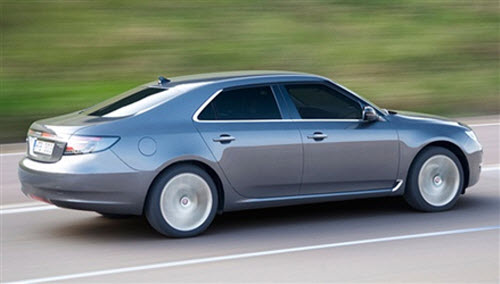
IMPORTANT NEWS: National Electric Vehicle Sweden has agreed to buy the assets of Saab Automobile and the sale is expected to be finalized during the summer.
Showing posts with label Saab design. Show all posts

Monday, April 4, 2011

Former Saab employees checked out the Saab PhoeniX concept

TTELA was at the Saab museum on Saturday and talked to Björn Envall and other former Saab epmloyees about the Saab PhoeniX concept:

PhoeniX makes a stopover in Trollhättan

PhoeniX landed temporarily at the Saab Car Museum on Saturday.
- It's good that finally something technical happens, says Saab's former chief designer Björn Envall, who liked Jason Castriota’s creation.
Björn Envall worked at Saab between 1969 and 1994. On Saturday he took the opportunity of looking at the concept of the future.
- The first really effective concept car compared to GM's concept car that was full of plastic parts. I would have wanted to hear the engine start as well.
Together with Bengt Gustafsson, who was at Saab between 1972 and 1998, and Astrid Marklund, at Saab 1967-2000, the three Saab-retired admired the company's future.

They found details they became quite fond of.
- I hope there will become something of this. There is still hope, says Astrid Marklund and points to the old logos that appear on several places.
She worked for the Saab's competition department until it was shut down. Her interest in cars is great.
- It is delicious. Very tasty. It builds on Saab's tradition says Björn Gustafson.
He was responsible for the Saab Group's purchasing department in the U.S. for ten years and has also worked with product development and sales.
The Saab museum had extended opening hours on Saturday and all employees had been told that the new concept was to behold.
- I found out about it through one of the two Saab Clubs that I'm a member of, says Andreas Rydell.
The 22-year-old from Trollhättan is a great Saab enthusiast. He now owns three cars: a 99 from 1974, a 900 convertible and a 9000.
- Look at the rims. They are like turbines, says Andreas Rydell, who likes what he sees.
He studies to become an engineer at the University of Halmstad.
- Hopefully there will be a job for me at Saab in the future, then I can contribute to the development and not just seeing the result when it’s finished.
On Saturday he was still very content to just get to see the PhoeniX.
There were many people who looked at the car for a long time, photographed, pointed and talked about all the details they discovered.
On a screen above was an interview with designer Jason Castriota who explained a little about the concept.
A concept that gives hope for the future for the Saab employees, former employees of Saab and maybe for the future Saab employees. And all others who depend on Saab's future.

Thursday, March 31, 2011

Saab 9-5 SportCombi vs. generic design

Okay, so after days writing about retirements, payment troubles and generally anything but cars, let's change focus and look at one thing that makes the new Saab 9-5 SportCombi so unique and classy.

In my opinion, in the last 10 years car design has become more and more generic. Soon you can't see the difference between an Audi and a Toyota. And that's not Audi's fault. Audi, together with BMW, Mercedes, Volvo, Saab and some other brands, have design cues that they hold on to. But many other brands, and maybe especially Asian brands, look to European car design and tries their best to give their cars a European touch.

Saab has some design cue that has been with them the last forty years: Hockey stick roof line, the wedge like stance, sloping C-pillars and rear window, wraparound windshield, three piece grille with a wing in the middle, front lights that sweep over to the sides. Even Saab has launched cars that haven't been 100 percent true to Saab's design cues, but these cues are more or less the Saab characteristics.

So over to the new 9-5 SportCombi. What makes this car so special? From the front and all the way to the rear doors it is more or less similar to the Sedan. But let's look from the C-pillars (the pillars behind the rear doors) and further back.

Here Saab use a modern take on the same design as on the previous Saab 9-5 SportCombi and more or less the same as on the upcoming 9-4X. The C-pillars are painted in the same color as the body and run from the roof and down to the rear arches, just like on the sedan version. From the C-pillars and back the windows and D-pillars are "blacked out". They look like a whole. It's only the roof line that is painted the same color as the body.

Picture "stolen" from Golfhunter at flickr.

First look at the picture of the Saab 9-5 SportCombi above, and then scroll down and look at the Audi A6 (Audi is coming with a replacement but it will probably look more or less the same), the BMW 5-series touring and the Mercedes E-class. They (and almost all other wagons like Skoda Superb, VW Passat, Toyota Avensis, Mazda 6, Peugeot 508, Citroen C5, Ford Mondeo, Opel Insignia etc etc) basically use the same generic design solution at the rear! Saab is a breath of fresh air in a gray mass of Wagons.


Also notice how flat the windshield are on all these cars except the Saab. That's another nice design element that makes the Saab unique.

Sunday, March 27, 2011

Auto Motor & Sport on upcoming 9-3 design and architecture

Swedish car magazine Auto Motor & Sport had a talk with Jason Castriota at the Geneva Motor Show. The interview and report from Geneva is available in issue number 6. Here are some of the information they got out of the Saab people in Geneva.


Low drag
Jason Castriota tells Auto Motor & Sport that he has gotten the drag coefficient of the next Saab 9-3 down to just 0.26. And as far as I can tell, that is actually very good. The current 9-3 SportSedan and the new 9-5 Sedan have drag coefficients of 0.28, which is also good, but not outstanding.

So why is a low drag coefficient so important? Well, because lower drag means lower fuel consumption and thus lower emissions. In todays market low consumption and low emissions are very important, especially in Europe where many countries tax emissions. The big challenge is to reduce drag and at the same time have enough downforce to give the car aerodynamic stability and great cornering ability.

The lowest drag coefficient I know of in normal production cars is 0.25, e.g. the Honda Insight and the Toyota Prius, but to me it seems like the Japanese had more focus on drag than beautiful design and impressive driving characteristics…

One car that has both a beautiful design and a low drag, and I assume great driving characteristics, is the new Mercedes-Benz CLS with a drag of just 0.26, the same Castriota says he has achieved with the new 9-3.

In addition to drag, size of the frontal area is also important, but on this we get no information about the new 9-3.

A side note about importance of drag
German car magazine AutoBild did a test a few years back (2008-04-11 issue) where they tested several cars in a wind tunnel. Their conclusions are very interesting:
  • Already at 50 to 80 km/h (depending on the car), aerodynamic drag becomes the most important factor for lower fuel consumption.
  • When comparing drag and weight by measuring by fuel consumption, reducing the Cd from 0.29 to 0.28 is like eliminating 100 kg vehicle weight

The design of the next 9-3
To AMS, Castriota says that the style of the upcoming 9-3 will not be as extreme as the PhoeniX concept. Instead it will be a mix of the balanced and beautiful lines of the Aero-X and the extreme shapes of the PhoeniX. Big parts of the front design of the PhoeniX are close to the 9-3 design. The most noticeable difference is the headlights which will be bigger on the 9-3. The body painted wing across the grille and into the head lights will follow over to the 9-3, as will the nicely shaped bonnet. The next 9-3 will get bigger and more prominent front wheel arches, and will also get a wraparound windshield. The hatchback will get an even flatter roof line and lower rear end than the PhoeniX concept.

About the architecture
Auto Motor & Sport tells us that Jan Åke Jonsson, when Saab was headed into a divorce from GM in 2008, wanted Saab to create their own basic vehicle structure. Technical director, Mats Fägerhag, then starting to plan a solution based on the Scania platform approach: One basic architecture shared by both the 9-3 and the 9-5, as well as the 9-4X. The name Phoenix was suggested by Kjell ac Bergström.

One advantage of the new platform compared to GM's delta platform, which the 9-3 was supposed to be built on under GM, is that the chassis and drive line is more than 100 kg lighter than GM-solution. Saab has also worked much on reducing the front overhang and thus moving the front wheels forward. This gives better driving characteristics and a more flexible engine bay which is suitable for different engine suppliers.


Doesn't a drag coefficient of just 0.26, lighter architecture and a design mix of the Aero-X and the PhoeniX sound exciting? I think so! 

Saturday, March 26, 2011

A video that looks closer at the new Saab 9-5 SportCombi

Want to take a close look at the new Saab 9-5 SportCombi? Then check out this video.


What can I say except for that this car looks stunning?!

Saturday, February 19, 2011

Ambient lighting

A few people have asked me if I can take some pictures that show the interior ambient lighting in the new Saab 9-5. This proved to be easier said than done. My cameras are just not good enough to make the ambient lighting justice. But nevertheless here I present the result. Just remember that a picture can never convey the real colours or the atmosphere.

First some facts: The ambient lighting consists of several LED lights that are supposed to create a warm atmosphere inside the cockpit. There are LEDs that lights up the door openers, the side pockets on the doors and the footwell on the driver's side. All LEDs are green.

Here's the lighting on the driver's door and footwell.


Another of the front passenger door.


That's the best my camera could do. My advise is to go to your dealer and take a test drive when the dark has fallen from the sky. 

Monday, December 6, 2010

Wraparound windshield

One of the design cues we frequently hear about from Saab is the wraparound windshield. It was made famous on the old classic Saabs and is mentioned in the same breath as the hockey-stick C-pillar and sloping roofline, the wedge-like stance, the three piece grille and so on. But one can wonder if the new Saabs have much of a wraparound windshield. I mean, it can't compare to the old Saab 99, right?

So I knew that the new Saab 9-5 has a curved windshield, but I assumed that it wasn't much different from what other cars have.


Then I saw a Toyota Avensis....


Wow, that is what I call a flat windshield! And compared to the Saab it looks so simple and cheap. It's details like this that makes Saabs great looking cars that you never grow tired of.

Tuesday, October 19, 2010

Chrome and black frames


So you think the previous generation 9-5 looks terrible with the chrome frames around the headlights?

 
And the wide black lines framing the "frosted" white tail lights on the 9-3 Sedan aren't much better?


Then lo and behold, they are both present on the new Saab 9-5!


But I guess one can argue that the use of chrome and black frames are much more sophisticated and subtle on the new 9-5. The frames around the headlights use matt chrome and are integrated into the rest of the grille, while the black edges on the rear lights are barely visible.
 
Do you still not like chrome and black frames?

Thursday, October 14, 2010

Signature lights and new wheels

I just had to snap a few pictures of the car with the new wheels and the signature lights on :)